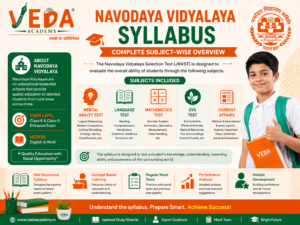
Preparing for the Jawahar Navodaya Vidyalaya entrance exam requires a clear understanding of the Navodaya Vidyalaya Syllabus. Students who know the syllabus in advance can organize their study schedule, select the right study material, and focus on important topics. The syllabus also helps students understand the subjects covered in the JNVST and the type of preparation required for the entrance examination.
For students preparing for JNVST Class 6, the syllabus generally focuses on areas such as Mental Ability, Arithmetic and Language. Students should understand each section properly and practice different types of questions regularly.
Understanding the Navodaya Vidyalaya Syllabus
The Navodaya Vidyalaya Syllabus is designed to evaluate a student’s reasoning ability, basic mathematical understanding and language skills. Instead of focusing only on memorization, the entrance examination requires students to apply concepts and solve questions within the given time.
For effective preparation, students should divide their study time according to the major sections of the JNVST syllabus. Regular practice can help students improve accuracy and become familiar with different question patterns.
Mental Ability Section
Mental Ability is an important part of the JNVST preparation. This section checks a student’s ability to understand patterns, relationships and logical situations.
Students can practice topics such as:
- Figure matching
- Classification
- Pattern completion
- Figure series
- Analogy
- Odd one out
- Mirror images
- Embedded figures
- Space visualization
- Geometrical figure completion
Regular practice is important because Mental Ability questions may require students to identify a pattern quickly. Solving previous year questions and mock tests can help students improve their speed.
Arithmetic Section
The Arithmetic section checks basic mathematical concepts and their application. Students should revise fundamental concepts and practice questions regularly.
Important areas for preparation may include:
- Number system
- Addition and subtraction
- Multiplication and division
- Fractions
- Decimals
- Factors and multiples
- Measurement
- Percentage
- Profit and loss
- Simple interest
- Average
- Ratio and proportion
- Time and distance
- Basic geometry
Students should not only memorize formulas but also understand how to apply them to different questions. JNVST Class 6 Notes, practice questions and model papers can be useful for revision.
Language Section
The Language section evaluates the student’s ability to understand and interpret a passage. Reading regularly can help students improve comprehension skills.
Students should practice:
- Reading comprehension
- Understanding passages
- Identifying the main idea
- Finding answers from passages
- Vocabulary
- Basic language understanding
Students should develop a habit of reading short passages and answering questions based on them. This can improve both reading speed and comprehension.
Importance of JNVST Class 6 Preparation
Understanding the Navodaya Vidyalaya Syllabus is only the first step. Students also need a proper preparation strategy. A simple study routine can include daily concept revision, question practice and regular mock tests.
Students can divide their preparation into three stages. First, they can understand basic concepts. Second, they can solve topic-wise questions. Finally, they can attempt full-length mock tests and previous year question papers.
This approach allows students to identify their weak areas and improve them before the examination.
Use Notes, PYQs and Model Papers
Good study material can make preparation more organized. Students can use JNVST Notes, previous year question papers, important questions and model papers for practice.
Previous year question papers are especially useful because they allow students to become familiar with the type of questions asked in the entrance examination. Model papers can also help students practice under exam-like conditions.
Students should maintain separate revision notes for difficult topics. Before the examination, these notes can be used for quick revision.
Practice Mock Tests Regularly
Mock tests are another useful part of JNVST preparation. Students can attempt mock tests after completing important topics. This helps them understand how much time they need for different sections.
After every mock test, students should check their mistakes. Instead of simply looking at the score, they should identify why an answer was incorrect. This can help improve accuracy and reduce repeated mistakes.
Click Here: Best Strategy to Score Full Marks in the JNVST Class 6 EVS Section
How to Make a Study Plan
A simple study plan can make JNVST Class 6 preparation easier. Students should divide their study time among Mental Ability, Arithmetic, Language and EVS (Environmental Studies). Since EVS is included in the Class 6 preparation, students should also practice basic EVS concepts and questions regularly. Along with syllabus revision, students can use notes, previous year questions, model papers and mock tests to improve their preparation.
Final Preparation Tips
Students preparing according to the Navodaya Vidyalaya Syllabus should focus on understanding concepts and practicing questions consistently. They should avoid leaving important topics for the last few days.
A useful preparation routine includes syllabus revision, JNVST Notes, important questions, previous year papers, model papers and mock tests. Students should also maintain a revision schedule so that previously studied topics are not forgotten.
Parents can support students by providing a quiet study environment and helping them maintain a regular routine. Students should stay consistent, review their mistakes and gradually improve their performance.