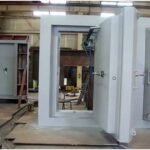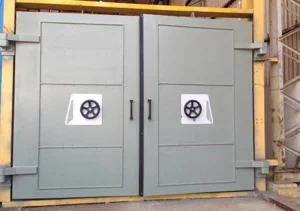
When most people think about explosion safety, they picture thick concrete walls or underground bunkers. Few consider the door — yet it’s often the single most vulnerable point in any blast-protected structure. A wall can be poured solid and unbroken, but a door has to open, close, seal, and sometimes lock in milliseconds under pressure loads that would crush ordinary steel. This is the engineering challenge that blast resistant doors are built to solve.
What Actually Happens During an Explosion
An explosion doesn’t just make noise — it creates a shockwave, a wall of compressed air that can travel faster than sound and strike a structure with enormous force within milliseconds. This is followed by a negative pressure phase that pulls outward, and often a rain of fragments and debris. A standard door assembly, even a heavy commercial one, can be torn from its hinges, blown inward as a projectile, or simply crumple — turning what should be a protective barrier into a secondary hazard.
Blast resistant doors are engineered to survive this entire sequence: absorbing the initial impact, resisting the rebound, and staying anchored to the frame throughout.
Not a One-Size-Fits-All Product
One of the most misunderstood aspects of blast doors is that there’s no universal design. Manufacturers engineer doors around specific threat scenarios, defined by:
- Peak overpressure — how much force, measured in psi, the door must withstand
- Duration and impulse — how long the pressure wave lasts, which affects how the door absorbs energy over time
- Standoff distance — how far the door is from the likely explosion source
- Threat type — vehicle-borne devices, industrial deflagration, or internal process explosions each produce different load profiles
A door rated for a petrochemical plant’s internal deflagration risk looks and performs very differently from one designed to resist a vehicle bomb at a courthouse entrance.
The Parts People Don’t See
The door slab itself — often layered steel with internal stiffening ribs — gets most of the attention, but the real performance often comes down to details:
- Frame anchoring that transfers blast load into the surrounding structural wall rather than letting the door become a weak seam
- Hinges and locking hardware engineered specifically for blast loading, since standard hardware fails long before the door panel does
- Compression seals that keep the door airtight, which matters both for blast pressure and, in some facilities, for chemical or biological containment
- Swing direction and hardware placement, carefully chosen so the door doesn’t become a hazard to people using it during a blast event
Where You’ll Find Them
Blast resistant doors show up far more often than most people realize — in embassies and military bases, obviously, but also in oil refineries, chemical plants, power generation facilities, mining operations, data centers, and increasingly in courthouses, airports, and other public buildings where security planning has become standard practice.
Certification Isn’t Optional
Because lives depend on these doors performing exactly as designed, they’re tested and certified against strict benchmarks — GSA guidelines and DoD standards like UFC 4-010-01 in the U.S., or EN 13123/13124 in Europe. Testing typically involves live blast trials or shock-tube simulation to validate that a door meets its rated pressure and impulse tolerance before it’s ever installed.
The Real Takeaway
Blast resistant doors sit at an unusual intersection of structural engineering, materials science, and everyday usability — they need to function like ordinary doors on a daily basis while being ready to perform like armor in a worst-case scenario. Specifying the right one isn’t a catalog decision; it requires a genuine risk assessment and close collaboration with structural engineers who understand the specific threat a facility faces.