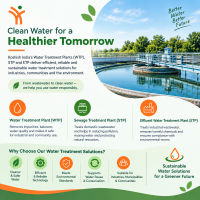
Clean and safe water is essential for homes, businesses, industries, and communities. However, water from natural or industrial sources can contain suspended particles, chemicals, microorganisms, and other impurities. A Water Treatment Plant (WTP) helps remove these contaminants and provides treated water suitable for drinking, commercial applications, or industrial use.
With increasing demand for clean water and better water management, water treatment plants in India are becoming an important part of sustainable water infrastructure.
What Is a Water Treatment Plant?
A Water Treatment Plant (WTP) is a system designed to purify water by removing physical, chemical, and biological impurities. Depending on the source and intended use of the water, different treatment technologies can be combined to achieve the required water quality.
A properly designed water treatment plant can help remove sediments, suspended solids, unwanted chemicals, bacteria, viruses, colour, odour, and other contaminants. The treated water can then be stored and supplied for appropriate residential, commercial, or industrial applications.
How Does a Water Treatment Plant Work?
The water treatment process generally involves several stages. Each stage performs a specific function to gradually improve water quality.
- Screening:
Raw water first passes through mechanical screens that remove larger materials such as plastic, stones, sand, debris, and other suspended solids. This protects the equipment used in later stages. - Coagulation and Flocculation:
Suitable treatment chemicals are added to help fine suspended particles come together and form larger particles called flocs. These particles become easier to separate from the water. - Sedimentation:
The water enters a settling tank where heavier flocs gradually settle at the bottom. This reduces suspended solids and makes the water clearer. - Filtration:
Water is passed through filtration media such as sand, gravel, and activated carbon. This stage helps remove fine particles and can improve colour, odour, and certain organic impurities. - Disinfection:
The treated water is disinfected using controlled levels of chlorine or another suitable disinfectant. This helps eliminate remaining microorganisms and pathogens. - Storage and Distribution:
After treatment, clean water is stored in hygienic tanks and distributed for its intended application.
Key Benefits of a Water Treatment Plant
A well-designed water purification system offers several practical and environmental benefits:
- Safe and clean water: Helps remove harmful contaminants and microorganisms.
- Health and hygiene: Reduces the risk associated with contaminated water.
- Regulatory compliance: Supports businesses and facilities in meeting applicable water-quality requirements.
- Water conservation: Promotes efficient use of available water resources.
- Cost savings: Can reduce dependence on external water sources and expenses associated with poor-quality water.
- Reliable water supply: Provides a consistent source of treated water for suitable applications.
Water Treatment Plant for Industrial and Commercial Applications
Industries and commercial facilities often require reliable water treatment solutions because water quality can directly affect their operations. A commercial water treatment plant or industrial water treatment plant can be designed according to factors such as raw-water quality, daily water requirement, contaminants, available space, and the required quality of treated water.
For wastewater-related requirements, solutions such as Sewage Treatment Plants (STP) and Effluent Treatment Plants (ETP) can complement water-management systems. STPs are generally used for domestic and sewage wastewater, while ETPs are designed for industrial effluents.
Why Choose Sustainable Water Treatment Solutions?
Sustainable water management is not only about treating water but also about using resources efficiently. Properly designed treatment systems can support water conservation, reduce environmental pollution, and improve the overall efficiency of water use.
Koshish India provides water treatment and wastewater solutions designed around specific site and operational requirements. Its water solutions include WTP, STP, ETP, and other water-management systems for different applications.
Conclusion
A Water Treatment Plant plays an important role in converting contaminated or untreated water into water suitable for its intended use. From screening and sedimentation to filtration and disinfection, every treatment stage contributes to better water quality.
For homes, commercial facilities, and industries looking for reliable water treatment solutions in India, selecting the right technology and treatment process is essential. With proper design, installation, and maintenance, a WTP can support clean water availability, water conservation, regulatory requirements, and long-term sustainable water management.
Domestic Biogas , Commercial Biogas , BioGas , Sewage Water Treatment Plant , Effluent Water Treatment Plant , Zero Liquid Discharge Water Treatment Plant