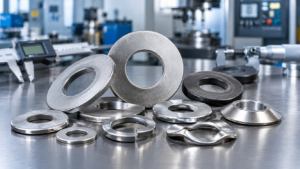
Industrial assemblies are expected to perform reliably under different operating conditions. From automotive equipment to heavy engineering machinery, every fastening component contributes to the strength and functionality of the finished product. A washer may be a small part of the assembly, but its quality can influence load distribution, surface protection and overall fastening performance.
For manufacturers and procurement professionals, understanding why washer quality matters is essential when selecting components for demanding industrial applications.
The Important Role of Washers in Fastening Systems
A washer is generally installed between a nut or bolt head and the connected surface. Its basic function is to distribute the applied fastening load across a wider area.
Without a suitable washer, concentrated pressure can damage surfaces, deform softer materials or affect the consistency of a fastening arrangement.
Depending on its design, a washer may also provide spring action, maintain spacing or accommodate small dimensional variations. These functions make washers useful in a wide range of mechanical and industrial applications.
How Quality Washers Improve Assembly Performance
1. Better Load Distribution
One of the main advantages of a properly manufactured washer is more uniform load distribution. A correctly dimensioned washer provides an appropriate contact area between the fastener and the mating surface.
This helps reduce localized pressure and supports the integrity of the assembled components.
2. Protection Against Surface Damage
During tightening, the rotating nut or bolt head can create friction against the connected material. A suitable washer provides a protective interface and helps minimize surface damage.
This is particularly useful when fastening components with softer or finished surfaces.
3. Consistent Dimensional Accuracy
Industrial assemblies frequently depend on precise dimensions. Variations in inner diameter, outer diameter or thickness can affect installation and assembly performance.
Quality manufacturing and dimensional inspection help ensure that washers meet the required specifications.
4. Improved Corrosion Protection
Washers exposed to moisture, chemicals or outdoor environments may require corrosion-resistant materials or protective coatings.
Stainless steel grades such as SS304 and SS316 are commonly considered for applications requiring corrosion resistance. Suitable surface finishes can provide additional protection according to operating conditions.
5. Reliable Mechanical Performance
Spring washers, wave washers and disc spring washers have specific functional requirements. Their performance depends on appropriate material properties, geometry and manufacturing control.
Using correctly specified components helps engineers maintain the intended characteristics of the assembly.
Why Material Selection Cannot Be Ignored
Different industrial environments demand different washer materials.
Carbon steel is a common option for general engineering and fastening applications. Stainless steel is often preferred where corrosion resistance is important. Spring steel is used for components requiring elastic behavior, while alloy steel may be selected for specific mechanical requirements.
The choice should consider:
- Applied load and operating pressure.
- Temperature and environmental exposure.
- Required hardness and mechanical properties.
- Corrosion resistance.
- Compatibility with connected components.
- Applicable engineering standards.
Selecting materials without considering these factors can result in premature deterioration or unsuitable performance.
The Importance of Manufacturing Standards
Manufacturing standards help establish consistency in product dimensions and specifications.
Industrial buyers may encounter standards such as ISO 7089, DIN 125A, DIN 127B, DIN 6796 and DIN 137A/B when sourcing washers.
However, the correct standard depends on the washer type and application. Buyers should verify the required specification instead of assuming that every washer follows the same dimensional requirements.
Quality assurance should also include dimensional checks, material verification, appropriate testing and batch traceability. These processes help maintain confidence in production consistency.
Choosing the Right Manufacturing Partner
Finding dependable suppliers is an important part of industrial procurement. The top Washer Manufacturers should understand application requirements and provide products that meet agreed specifications.
Before placing an order, buyers should evaluate:
Product range: Does the manufacturer offer plain, spring lock, wave and specialty washers?
Material options: Are suitable steel and stainless steel grades available?
Dimensional control: Can the manufacturer maintain specified dimensions and tolerances?
Quality assurance: Are inspection and testing procedures followed?
Customization: Can the supplier discuss non-standard dimensions and application-specific requirements?
Supply reliability: Can the manufacturer support repeat orders and consistent deliveries?
EASCO offers industrial washer solutions for different engineering and fastening requirements. Its product range gives industrial buyers an opportunity to explore suitable washer designs, materials and finishes for their applications.
The Long-Term Value of Quality Procurement
Choosing washers solely on the basis of initial price can overlook important quality considerations. Inconsistent dimensions, unsuitable materials and inadequate finishes may create problems during assembly or service.
A more effective procurement strategy considers product specifications, manufacturing quality, application suitability and supplier reliability together.
For OEM manufacturers and engineering companies, this approach supports more predictable purchasing and helps maintain consistency across production batches.
Conclusion
Quality washers contribute to the performance of industrial fastening systems through load distribution, surface protection, dimensional accuracy and application-specific mechanical functions.
Selecting the correct design and material is essential, but choosing a capable manufacturing partner is equally important. By evaluating technical specifications and quality-control practices, buyers can source washers that meet their engineering requirements.
Frequently Asked Questions
1. Why are washers important in industrial assemblies?
Washers distribute fastening loads, protect connected surfaces and provide additional functions depending on their design.
2. Can poor-quality washers affect machinery performance?
Yes. Incorrect dimensions, unsuitable materials or inadequate finishes can affect assembly quality and component reliability.
3. Which washer material is best for industrial use?
Carbon steel, stainless steel and spring steel are common options. The correct material depends on operating conditions and engineering requirements.
4. How can buyers identify quality Washer Manufacturers?
Check manufacturing capabilities, material specifications, dimensional accuracy, quality inspections and delivery consistency.
5. Are customized industrial washers available?
Manufacturers may offer customized washers based on specified dimensions, materials, thicknesses and finishing requirements.