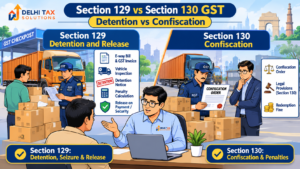
Section 129 vs 130 GST: Complete Guide to Detention, Confiscation and Penalties in 2026
By Delhi Tax Solutions | Indian GST and Tax Compliance
Section 129 vs 130 GST is an important distinction for Indian transporters, manufacturers, traders and business owners. Both provisions of the Central Goods and Services Tax (CGST) Act, 2017 deal with enforcement action involving goods and conveyances. However, they have different legal purposes and consequences. Section 129 deals with detention, seizure and release of goods in transit, whereas Section 130 deals with confiscation and levy of penalty. Understanding these provisions can help businesses respond appropriately to GST notices and transportation-related compliance issues.
What Is Section 129 of the CGST Act?
Section 129 of the CGST Act deals with detention, seizure and release of goods and conveyances in transit.
When a person transports goods or stores goods while they are in transit contrary to GST provisions or applicable rules, the goods, conveyance and relevant documents may become liable to detention or seizure.
Common transportation compliance issues include:
-
Missing or incorrect GST invoices.
-
Invalid or expired e-way bills.
-
Incorrect vehicle numbers.
-
Mismatched goods descriptions or quantities.
-
Other violations of applicable GST transportation requirements.
The proper officer must follow the statutory procedure before determining the applicable penalty.
What Is the Penalty Under Section 129 GST?
The penalty depends on whether the owner of the goods comes forward for payment.
When the owner comes forward:
For taxable goods, the penalty is 200% of the tax payable on the goods.
For exempt goods, the amount is 2% of the value of the goods or ₹25,000, whichever is less.
When the owner does not come forward:
For taxable goods, the penalty is the higher of:
-
50% of the value of the goods; or
-
200% of the tax payable on the goods.
For exempt goods, the amount is 5% of the value of goods or ₹25,000, whichever is less.
Section 129(1)(c) also allows release through prescribed security equivalent to the applicable penalty.
These amended penalty provisions have applied since 1 January 2022.
Section 129 Penalty Calculation Example
Suppose a transporter carries taxable goods worth ₹1,00,000 and the applicable GST rate is 18%.
The tax payable is ₹18,000.
Scenario 1: Owner comes forward
200% of ₹18,000 = ₹36,000 penalty.
Scenario 2: Owner does not come forward
-
50% of goods value = ₹50,000.
-
200% of tax payable = ₹36,000.
The higher amount is ₹50,000.
This example demonstrates how the current penalty calculation works under Section 129(1).
What Is Section 130 of the CGST Act?
Section 130 of the CGST Act deals with confiscation of goods or conveyances and levy of penalty.
Confiscation is a serious statutory consequence. Once goods or conveyances are confiscated, their title vests in the government under Section 130(5).
Section 130(1) provides five statutory grounds for confiscation.
These include:
-
Supplying or receiving goods contrary to GST provisions with intent to evade payment of tax.
-
Failing to account for taxable goods.
-
Supplying taxable goods without having applied for registration.
-
Contravening GST provisions with intent to evade payment of tax.
-
Using a conveyance to transport goods contrary to GST provisions, unless the owner proves that the misuse occurred without the owner’s knowledge or connivance, including that of the owner’s agent or person in charge.
An important legal distinction is that intent to evade tax is expressly required under certain grounds, but not every ground under Section 130 contains the same requirement.
Therefore, the relevant statutory ground and supporting evidence must be examined before confiscation proceedings are decided.
What Is the Redemption Fine Under Section 130?
Section 130(2) allows the adjudicating officer to provide the owner an option to pay a fine instead of confiscation.
The redemption fine cannot exceed the market value of the confiscated goods minus the tax chargeable on them.
The aggregate of the redemption fine and penalty cannot be less than 100% of the tax payable on the goods.
A separate provision applies to a conveyance used for transporting goods or passengers for hire. The owner may be offered an option to pay a fine equal to the tax payable on the goods being transported instead of confiscation of the conveyance.
Section 130(4) also provides that an order of confiscation or penalty cannot be passed without giving the concerned person an opportunity of being heard.
These safeguards are important for businesses facing confiscation proceedings.
Section 129 vs 130 GST: What Are the Main Differences?
The two sections have different purposes, procedures and financial consequences.
| Particulars | Section 129 | Section 130 |
|---|---|---|
| Main purpose | Detention, seizure and release | Confiscation and penalty |
| Nature | Goods and conveyances in transit | Confiscation proceedings |
| Applicability | Transportation or storage in transit contrary to GST provisions | Five specified statutory grounds |
| Intent requirement | Not a general prerequisite under Section 129(1) | Expressly required under certain grounds |
| Penalty | Specified penalty calculation | Penalty under Section 122 |
| Release mechanism | Payment or prescribed security | Redemption option |
| Ownership | Detention does not itself transfer title | Title vests in the government after confiscation |
| Hearing protection | Section 129(4) | Section 130(4) |
The key distinction is that detention under Section 129 does not automatically establish that confiscation under Section 130 is justified.
What Are the Important Timelines Under Section 129?
Section 129(3) establishes specific statutory timelines for detention proceedings.
Seven-day notice period: The proper officer must issue a notice within seven days of detention or seizure, specifying the penalty payable.
Seven-day order period: The officer must pass the penalty order within seven days from the date of service of the notice.
Opportunity of hearing: Section 129(4) requires the concerned person to receive an opportunity of being heard before the penalty is determined.
Fifteen-day payment period: Under Section 129(6), the penalty must be paid within 15 days from receipt of the order. Otherwise, the detained goods or conveyance may become liable to sale or other disposal under the prescribed procedure.
A separate provision allows release of the conveyance when the transporter pays the penalty under the order or ₹1 lakh, whichever is less.
The 15-day payment period may be reduced in cases involving perishable, hazardous or depreciating goods.
Businesses should therefore respond to detention notices without unnecessary delay.
What Should Businesses Do When Goods Are Detained?
Businesses and transporters should follow a systematic approach.
Step 1: Collect the relevant documents.
Obtain the detention order, notice, tax invoice and e-way bill.
Step 2: Identify the alleged violation.
Check whether the issue relates to invoice details, vehicle information, goods descriptions or e-way bill validity.
Step 3: Reconcile transportation records.
Compare the actual goods with the invoice, delivery challan and e-way bill details.
Step 4: Identify the applicable legal provision.
Determine whether the proceedings concern Section 129 or Section 130.
Step 5: Prepare a factual response.
Submit relevant supporting documents and explanations within the applicable statutory timelines.
Step 6: Evaluate legal remedies.
Where an order appears legally unsustainable, examine the appropriate statutory appeal or other available remedy with a qualified professional.
Common Legal and Compliance Mistakes
Businesses should avoid assuming that every transportation discrepancy justifies confiscation.
Common mistakes include:
-
Treating Section 129 and Section 130 as interchangeable.
-
Using outdated Section 129 penalty calculations.
-
Ignoring the distinction between detention and confiscation.
-
Failing to examine the specific Section 130 ground.
-
Missing the statutory notice and payment timelines.
-
Not preserving transportation and invoice records.
-
Responding to legal notices without examining supporting evidence.
A proper GST document-management system can help businesses maintain reliable records and respond more efficiently to enforcement proceedings.
Quick Summary: Section 129 vs 130 GST
| Legal point | Section 129 | Section 130 |
|---|---|---|
| Process | Detention and seizure | Confiscation |
| Main objective | Release of goods and conveyance | Confiscation under specified grounds |
| Penalty mechanism | Section 129(1) | Section 130 read with Section 122 |
| Statutory hearing | Section 129(4) | Section 130(4) |
| Ownership transfer | No automatic transfer through detention | Vests in government after confiscation |
Frequently Asked Questions
1. What is the main difference between Section 129 and Section 130 GST?
Section 129 deals with detention, seizure and release of goods and conveyances in transit. Section 130 deals with confiscation and penalty when one of its specified statutory grounds is established. Detention does not automatically transfer ownership to the government, whereas confiscation results in the title of the confiscated property vesting in the government.
2. What is the current penalty under Section 129 GST?
For taxable goods, the penalty is 200% of tax payable when the owner comes forward. When the owner does not come forward, the penalty is the higher of 50% of goods value or 200% of tax payable. Different calculations apply to exempt goods. These amended calculations have been applicable since 1 January 2022.
3. Can an expired e-way bill result in confiscation?
An expired e-way bill may lead to detention proceedings where transportation violates applicable GST requirements. However, confiscation under Section 130 requires examination of the specific statutory grounds. An expired e-way bill alone should not automatically be treated as proof of every ground for confiscation.
4. What is the time limit for issuing a Section 129 notice?
Section 129(3) requires the proper officer to issue a notice within seven days of detention or seizure. The officer must pass the penalty order within seven days from service of the notice. The concerned person must also receive an opportunity of being heard before the penalty is determined.
5. Can a business challenge a confiscation order under Section 130?
Businesses can examine the available statutory remedies against a confiscation order. The appropriate remedy depends on the facts, supporting evidence, nature of the order and applicable limitation period. Businesses should preserve detention notices, confiscation notices, tax invoices, e-way bills and other records before seeking professional legal assistance.
Conclusion
Understanding Section 129 vs 130 GST is essential for Indian transporters, manufacturers and businesses involved in goods transportation.
Section 129 deals with detention, seizure and release of goods in transit. Section 130 deals with confiscation and its related legal and financial consequences.
Businesses should maintain accurate GST invoices, valid e-way bills and proper transportation records. They should also carefully examine GST notices before making payments or preparing a legal response.
For further practical reading, refer to the Section 129 vs Section 130 GST guide.
Official legal reference: Central Goods and Services Tax Act, 2017 – India Code.
Disclaimer: This article is for general informational purposes and is not a substitute for personalised GST or legal advice. The appropriate legal treatment depends on the facts and applicable statutory provisions.
Author Bio: Delhi Tax Solutions publishes educational resources covering GST, Indian taxation, business registration and regulatory compliance. Its content focuses on practical tax information for Indian businesses, professionals and taxpayers.