Personal data has become an important business asset. Organisations use customer information to personalise services, manage transactions, improve marketing campaigns and develop better customer experiences. However, as data collection expands, businesses must also take greater responsibility for protecting individuals’ privacy.
In India, the Digital Personal Data Protection (DPDP) Act, 2023 establishes a framework for processing digital personal data. For organisations that rely on customer information, preparing for the Act requires more than updating privacy policies. It involves reviewing how consent is collected, recorded, managed and withdrawn.
A structured consent management checklist can help businesses identify compliance gaps and assign responsibility for addressing them.
Understanding Consent Management Under the DPDP Act
The DPDP Act places importance on clear, informed and specific consent where consent is the applicable basis for processing personal data.
Under Section 6, consent should be free, specific, informed, unconditional and unambiguous, with a clear affirmative action.
Businesses should also remember that not every processing activity necessarily requires consent. Certain legitimate uses are recognised under Section 7, and organisations should assess the appropriate legal basis for each processing purpose.
This makes it important to understand exactly what personal data is collected, why it is collected and how it is used.
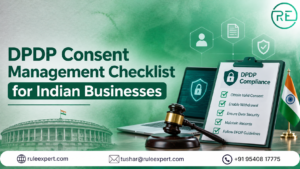
A Seven-Point Consent Management Checklist
1. Identify Personal Data and Processing Purposes
The first step is understanding what information the organisation collects.
Businesses should prepare an inventory of personal data, including:
- Customer names and contact information.
- Account and transaction information.
- Website and application usage data.
- Employee and candidate information.
- Information shared with service providers.
Each data category should be connected to a specific processing purpose and the systems where the information is stored.
This helps organisations identify unnecessary data collection and clarify which activities require consent.
2. Review Privacy Notices
Privacy notices should explain how personal data is processed in a clear and accessible manner.
Businesses should review whether their notices explain:
- The personal data being collected.
- The purpose of processing.
- How individuals can withdraw consent.
- How individuals can exercise their rights.
- How grievances can be raised.
The notice should be presented in accordance with the applicable DPDP Rules, including the requirement for an accessible, standalone notice with appropriate details.
3. Improve Consent Collection Mechanisms
Consent collection should involve a clear affirmative action.
Businesses should review registration forms, website pop-ups, mobile application permissions and other customer-facing interfaces.
Good practices include keeping consent options separate for different purposes, avoiding pre-selected consent boxes and ensuring that unrelated services are not made conditional on optional consent.
For example, agreeing to receive promotional messages should not automatically be bundled with consent needed for an unrelated service.
4. Maintain Verifiable Consent Records
Collecting consent is only part of the process. Businesses must also be able to demonstrate that consent was obtained appropriately.
A reliable record should include:
- The date and time of consent.
- The applicable privacy notice version.
- The purpose of processing.
- The collection channel.
- The relevant consent status.
- Subsequent modifications or withdrawals.
Maintaining a reliable history helps organisations respond to audits, disputes and internal compliance reviews.
5. Create a Consent Withdrawal Process
Individuals must be able to withdraw consent as easily as they provided it.
Businesses should establish a documented process for receiving requests, recording them, updating internal systems and notifying relevant processors.
It is also important to define internal turnaround targets and identify the person or team responsible for completing each request.
6. Review Third-Party Vendors and Children’s Data
Personal data often moves between organisations and external service providers.
Businesses should maintain an updated vendor register showing which providers receive personal data and for what purpose.
Contracts and operational procedures should address how processors follow relevant instructions, including consent changes.
Where children’s personal data is involved, organisations must also assess the additional obligations under Section 9, including applicable verifiable parental consent requirements and restrictions.
7. Prepare for Consent Manager Integration
The DPDP framework recognises Consent Managers as an additional channel through which individuals may manage their consent.
Businesses should assess whether their technology infrastructure can receive and process consent-related decisions originating outside their own websites or applications.
Preparing flexible integration capabilities can help organisations adapt as the regulatory and technical ecosystem develops.
How Should Businesses Conduct a Consent Audit?
A checklist becomes useful when every requirement is supported by evidence.
Organisations can classify each requirement into three categories:
- Pass: The control is implemented and supporting evidence exists.
- Partial: The control exists but has operational or documentation gaps.
- Fail: The control is missing or cannot be demonstrated.
For example, a company may have an updated privacy notice but lack records showing which version was presented to each customer.
Similarly, a business may offer an unsubscribe link but have no documented procedure for notifying its external marketing vendors.
These findings help compliance teams prioritise improvements rather than treating every issue as equally urgent.
Assign Responsibility Across Departments
Consent management should not be handled by the legal department alone.
An effective programme requires coordination between several functions:
- Legal and compliance teams should review regulatory requirements and privacy notices.
- IT teams should manage data inventories, integrations and audit logs.
- Marketing teams should maintain accurate communication preferences.
- Product teams should improve consent collection and withdrawal experiences.
- Procurement teams should review relevant third-party agreements.
Clearly assigned ownership makes compliance activities easier to monitor and maintain.
Conclusion
Preparing for the DPDP Act requires Indian businesses to establish a systematic approach to consent management. From identifying processing purposes to maintaining records and handling withdrawal requests, each stage should be supported by clear processes and verifiable evidence.
Businesses can use this comprehensive DPDP consent management checklist for Indian businesses as a practical reference when evaluating their existing privacy practices.
A well-maintained checklist can help organisations identify weaknesses, improve accountability and build a stronger foundation for data protection compliance.
Disclaimer: This article is for general informational purposes and should not be treated as legal advice.