Why Location Intelligence Is the Most Powerful Tool in Healthcare Marketing Today
Healthcare marketing operates under constraints that most other industry categories don’t face. Regulatory requirements limit what can be claimed about treatments and outcomes. The emotional sensitivity of health decisions demands a different tone than consumer product advertising. And the patient’s decision-making process — which typically involves research, consideration, and anxiety in ways that product purchases don’t — requires marketing approaches calibrated to a different kind of intent.
Within these constraints, however, one dimension of healthcare marketing has been genuinely transformed by digital technology: the ability to reach potential patients based on where they are, where they’ve been, and what their physical proximity to a healthcare facility or service suggests about their likelihood of needing care. Location intelligence — the use of geographic data to inform marketing targeting — has become one of the most practically effective tools available to healthcare marketers in India’s increasingly competitive healthcare landscape.
Why Geography Is Central to Healthcare Decision-Making
Healthcare is one of the most geographically anchored consumer categories in existence. Unlike a software product or an online service, healthcare requires physical attendance — a patient must travel to a clinic, hospital, or diagnostic centre to receive care. The distance a patient is willing to travel for healthcare varies significantly by urgency, specialty, and individual circumstance, but proximity consistently emerges as one of the primary factors in hospital and clinic selection across research on healthcare consumer behaviour.
This geographic anchoring creates a marketing dynamic that is different from most other categories. Reaching the right person in the wrong location — someone who sees an advertisement for a hospital that is forty-five minutes from their home when adequate local alternatives exist — is significantly less efficient than reaching someone who is geographically positioned to realistically use the advertised service.
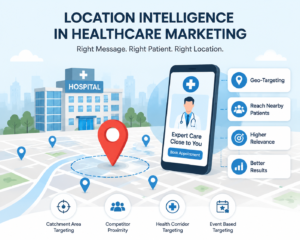
GEO service capabilities in digital advertising address this dynamic directly — allowing healthcare marketers to define geographic catchment areas around specific facilities, target users currently within those catchment areas, or identify users who have recently been in proximity to medical facilities in ways that signal health-seeking behaviour.
Practical Applications of Geo-Targeting in Healthcare Marketing
The practical applications of location intelligence in healthcare marketing are broader than simple radius-based targeting around a hospital’s address.
Catchment area optimisation is the most fundamental application. Rather than advertising a hospital’s services to an entire city, geo-targeting allows campaigns to focus on the neighbourhoods and areas from which the hospital realistically draws patients — the catchment area defined by travel time, road access, and historical patient origin data. This concentration of advertising spend within the actual catchment area produces significantly better cost-per-acquisition than city-wide campaigns that include large proportions of geographically unreachable audiences.
Competitor proximity targeting allows hospitals and clinics to reach users who are in the vicinity of competing facilities — potential patients who are actively in the area of a competitor but who may be researching alternatives or are accessible for brand awareness building before their final facility selection.
Health corridor targeting uses proximity to specific locations — pharmacies, diagnostic centres, specialist clinic clusters — as a signal of health-seeking behaviour that warrants healthcare advertising exposure. A user who regularly visits a pharmacy in a specific area is exhibiting health-engaged behaviour that makes healthcare advertising more relevant than for the general population.
Event-based geo-targeting uses presence at specific events or locations — health camps, medical expos, corporate wellness programs — as a targeting signal for follow-up healthcare advertising in the days and weeks after the event.
Why Healthcare Marketing Requires Specialist Digital Expertise
The effectiveness of digital marketing for healthcare is significantly affected by the regulatory and ethical frameworks that govern healthcare advertising in India. Advertising Standards Council of India guidelines, Medical Council of India regulations, and the specific constraints on claims about treatment outcomes and comparative efficacy all shape what healthcare marketing can say and how it can say it.
Navigating these frameworks while still creating advertising that motivates patient action requires both regulatory knowledge and creative discipline — understanding what language works within the constraints, how to frame service quality and expertise claims honestly, and how to build patient trust through digital channels without crossing into claims that regulatory bodies would challenge.
For hospitals, diagnostic chains, specialty clinics, and pharmaceutical brands navigating this landscape, working with agencies that have developed specific expertise in healthcare marketing services is the practical path to digital campaigns that are both effective and compliant.
The Digital Patient Journey in India’s Healthcare Market
India’s healthcare consumer is increasingly digitally informed before, during, and after the healthcare decision. Google searches for symptoms, condition information, and local healthcare providers have become a standard part of the patient’s pre-visit research process. Review platforms influence hospital and doctor selection. Post-treatment follow-up and health management are increasingly happening through digital channels.
This digital engagement at multiple stages of the patient journey creates touchpoints for healthcare marketing that didn’t exist a decade ago — and that require different marketing approaches at each stage. Awareness-building for a hospital’s specialty capabilities, intent-capture for patients actively searching for services, and retention marketing for existing patients all require different creative approaches, different channel mixes, and different measurement frameworks.
Geo-targeting functions differently at each stage. Awareness campaigns benefit from broader catchment-area targeting. Intent-capture campaigns benefit from proximity signals around the facility. Retention campaigns benefit from location data that identifies existing patients near the facility when appointment reminders or health programme promotions are relevant.
Integrating Location Intelligence With Broader Campaign Strategy
Location intelligence is most powerful when integrated into a broader campaign strategy rather than used as a standalone targeting tactic. CTV advertising builds awareness and brand preference among audiences in defined geographic markets. Search advertising captures patients actively seeking services in the area. Social and display retargeting maintains visibility with patients who have previously engaged with healthcare content. And geo-targeted formats provide the location-specific layer that connects all of these impressions to the physical proximity that drives healthcare attendance.
For healthcare brands evaluating their digital marketing approach in India, working with an experienced internet advertising agency that understands both the technical capabilities of location-based targeting and the specific constraints of healthcare marketing provides the integrated strategic and executional expertise that makes these capabilities produce genuine patient acquisition outcomes.
Adomantra operates across the full spectrum of digital advertising formats — including geo-targeting, CTV, programmatic, and specialty healthcare-focused digital — providing healthcare clients with integrated campaign management that reflects the complexity of the patient acquisition challenge rather than treating it as standard consumer marketing with different creative.
The Competitive Healthcare Marketing Moment
India’s private healthcare sector is increasingly competitive. Patients have more information, more choices, and stronger preferences than at any previous point in the market’s development. The healthcare organisations that build sophisticated, location-intelligent digital marketing capabilities now are establishing patient acquisition advantages that will be significantly more expensive to build once the market matures further.
Location intelligence is not the only tool in healthcare marketing — but for the geographically anchored, proximity-sensitive, patient-journey-complex nature of healthcare decision-making in India, it is one of the most underused and highest-return tools currently available.