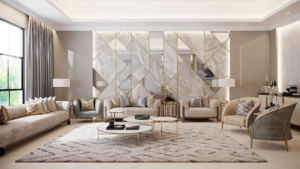
Large living rooms provide freedom, but they can also present a design challenge.
A single central fixture rarely illuminates such a space effectively. Some areas may become too bright while corners remain dark. Furniture can also become disconnected when the lighting does not follow the room’s zones.
The solution is a layered layout that responds to the size and function of the space.
Establish a Main Focal Point
Large living rooms usually benefit from one strong visual anchor.
A chandelier above the central seating area can establish that hierarchy.
When considering Chandeliers In Dubai, look at the room’s dimensions, ceiling height, sofa arrangement, and overall interior style before choosing a size.
Avoid Overwhelming the Seating Area
A dramatic fixture should enhance the furniture rather than dominate it.
Its width and vertical drop should be appropriate to the seating arrangement.
Divide the Room Into Functional Zones
Begin with the furniture.
Identify the main seating arrangement, reading areas, conversation zones, entertainment area, and circulation paths.
Let Furniture Determine Fixture Positions
Lighting should support how the room is used.
A reading chair needs focused illumination. A conversation area benefits from softer surrounding light. Artwork may require accent illumination.
This approach is more effective than placing fixtures according to the ceiling grid alone.
Add General Ceiling Illumination
The central decorative fixture should not be responsible for the entire room.
Recessed fixtures or other broad sources can provide general illumination around the perimeter.
This allows the main centrepiece to operate as part of a larger lighting system.
Illuminate the Corners
Corners are frequently overlooked in large spaces.
Dark corners can make the room feel unfinished.
Floor-standing sources, wall illumination, or accent fixtures can bring these areas into the overall composition.
Use Vertical Illumination
Light directed onto walls can visually expand the room.
It also helps balance the brightness of the central area.
Create a Reading Zone
A reading chair or lounge area can have its own lighting layer.
A floor fixture positioned beside the chair can provide focused illumination without requiring the whole room to be bright.
This makes the space more versatile.
Highlight Artwork and Architecture
Large rooms often contain feature walls, artwork, shelves, columns, fireplaces, or decorative niches.
Use accent illumination selectively.
A few highlighted features can create visual hierarchy.
Avoid illuminating everything equally.
Consider the Coffee Table Area
The centre of a living room is often defined by the coffee table.
Its relationship with the surrounding sofa and lighting matters.
A low-profile Glass Console/كونسول زجاج or similar transparent furniture piece elsewhere in the room can help maintain visual openness, particularly when the space already contains substantial furniture.
The same principle applies to the central table: furniture should not visually block the flow of light.
Use Floor-Level Illumination
Lower sources create another visual layer.
They can illuminate plants, architectural edges, side tables, and seating areas.
Keep Walkways Clear
Large rooms need clear circulation.
Position floor fixtures where they cannot become obstacles.
Cables should be secured and kept away from common walking routes.
Make the Room Adaptable
A large living room may host different activities.
Family gatherings, entertaining, reading, television viewing, and quiet evenings all require different atmospheres.
Separate lighting circuits and dimmers allow the room to change without moving furniture.
Use Accent Lighting Carefully
Accent fixtures can draw attention to selected details.
Artwork, shelving, textured walls, and decorative objects can each become focal points.
The secret is restraint.
Avoid Competing Focal Points
If every area receives strong accent illumination, the room can feel visually chaotic.
Choose one primary feature and several supporting details.
Consider Natural Daylight
Large living rooms often have substantial windows.
Observe how daylight enters the room at different times.
Some fixtures may be unnecessary during the day but become important after sunset.
Curtains and blinds also influence the transition from natural to artificial light.
Think About Ceiling Height
High ceilings offer more freedom for dramatic fixtures.
Lower ceilings require greater restraint.
The vertical drop of a chandelier or pendant should maintain comfortable clearance above people and furniture.
Create a Layered Evening Scene
A sophisticated large living room rarely needs every light switched on.
A strong evening arrangement might combine:
- Reduced general ceiling illumination
- A central decorative fixture
- Wall illumination
- Reading light
- Selected accent sources
- Subtle floor-level lighting
This creates depth without excessive brightness.
Build the Layout Around People
The best lighting plan is one that follows human behaviour.
People sit in particular places. They read in particular corners. They walk along predictable paths and gather around furniture.
When illumination follows these patterns, the room feels natural.
Large living rooms do not need to be filled with fixtures. They need carefully distributed light at different heights and intensities.
A central statement piece can establish the room’s identity, while ceiling sources provide general brightness, wall fixtures add depth, and lower-level lamps create intimate zones.
The result is a living room that feels spacious without feeling empty, luxurious without being excessive, and flexible enough to support everyday life as well as special occasions.