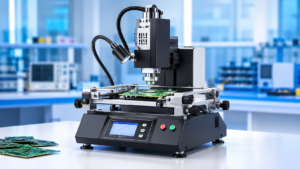
Electronics manufacturing involves complex PCB assemblies where even a small component defect can affect the performance of an entire electronic product. Ball Grid Array (BGA) components are widely used because they provide high connection density within a compact package. However, repairing these components presents several technical challenges.
A BGA Rework Station helps technicians manage component removal and replacement through controlled heating, temperature monitoring, and accurate positioning. Understanding common BGA rework challenges is important for production engineers, PCB repair professionals, and electronics manufacturing companies.
Understanding Common BGA Rework Challenges
1. Hidden Solder Connections
BGA components have solder balls underneath the package, making their connections difficult to inspect visually.
Unlike conventional components with exposed leads, BGA solder joints require specialized inspection and rework procedures. X-ray inspection is often used to evaluate hidden solder connections when required.
2. Uneven Temperature Distribution
Uneven heating is one of the major concerns during BGA rework.
If the PCB does not receive suitable thermal treatment, some areas may experience excessive heating while others remain below the required temperature. This can lead to incomplete solder melting, component damage, or PCB warpage.
A rework system with suitable top and bottom heating capabilities helps operators manage thermal distribution.
3. PCB Warpage
Excessive temperature differences can cause PCB deformation during the rework cycle. This is particularly important when working with multilayer boards and large circuit assemblies.
Controlled preheating and suitable temperature profiles help reduce thermal stress.
4. Component Alignment Problems
Accurate positioning is essential when replacing BGA components. Misalignment can result in poor solder connections and electrical failures.
Camera-assisted alignment systems can help technicians position replacement components more accurately before the soldering process.
5. Damage to Nearby Components
Modern PCB assemblies often contain closely spaced electronic components. Excessive heat or uncontrolled airflow can affect surrounding components.
Suitable nozzle selection, controlled airflow, and proper heating profiles are important for minimizing unnecessary thermal exposure.
How a BGA Rework Station Helps Address These Challenges
A suitable BGA Rework Station combines heating technology, temperature control, and component positioning features to support controlled repair operations.
Multi-zone heating helps manage thermal distribution, while programmable profiles allow technicians to follow application-specific temperature requirements.
Optical alignment systems assist component positioning, and adjustable airflow provides greater control during the heating process.
However, equipment alone cannot guarantee successful rework. Operator training, PCB inspection, component handling, and process validation remain essential.
Factors to Consider Before Purchasing
Electronics manufacturers should evaluate their regular PCB repair requirements before purchasing rework equipment.
Important considerations include PCB dimensions, component package types, heating zones, temperature accuracy, nozzle availability, alignment technology, and daily operating workload.
Buyers are researching BGA Rework Station Manufacturers in India should also examine technical support, product documentation, spare parts availability, and supplier experience.
Reliable Spares & Consumables offers equipment options is for electronics manufacturing and PCB repair applications. Explore the BGA Rework Station range for further product information.
Companies can also consider suitable ESD protection products to support safe handling practices in electronics workstations.
Importance of Proper Rework Procedures
A structured rework process should include initial PCB inspection, component identification, temperature profile selection, controlled component removal, pad preparation, component alignment, and post-rework inspection.
Following the component manufacturer’s recommendations is essential. Where appropriate, technicians should use X-ray inspection and electrical testing to verify the quality of the repaired assembly.
Conclusion
BGA rework involves several technical challenges, including hidden solder joints, thermal management, PCB warpage, and component alignment. Using a suitable BGA Rework Station and following established repair procedures can help electronics manufacturers manage these challenges more effectively.
Selecting equipment based on actual PCB requirements, supported component packages, and technical capabilities is important for maintaining reliable manufacturing and repair operations.