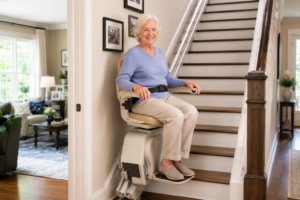
Spotting a used stair lift for sale at half the price of a new one feels like a lucky break. Then you look at your own staircase. It turns at a landing, or it bends in a gentle arc toward the second floor. Now the real question is not price. It is fit. Can a secondhand lift handle those curves? In most cases, the answer is no, at least not without major changes. This guide explains why, what your options look like, and how to avoid paying for a lift that never works in your home.
Why Curved Stairs Change Everything
A straight staircase is simple. The rail runs in one line from bottom to top, and the lift rides along it. Makers produce these rails in standard lengths and cut them to size. That is why used straight lifts move easily from one home to another.
A curved staircase breaks that pattern. The rail has to follow every bend, angle, and landing. It must also keep the seat level as it turns. Because no two staircases curve the same way, each rail is built to order. A tech measures your stairs and sends the numbers to the factory. The factory then builds a rail that matches. The process often takes several weeks.
What Makes a Curved Rail Hard to Reuse
Think of a curved rail like a custom suit. It fits one person well and almost nobody else. The radius of the turn, the length of each section, the angle of the climb, and the spot where the rail ends all come from one specific house.
A used curved lift also has fewer places to go. A rail from a spiral staircase in one home will almost never match the stairs in another. Even a small difference in the turn angle can leave the rail short, crooked, or unsafe. Fixing that means sending it back to the maker for a rebuild. The cost can come close to the price of a new rail.
Because of this, most dealers do not stock used curved lifts. When you see one online, ask why it is still available. Often the owner cannot find a buyer, since the rail only suits one staircase.
Common Curved Layouts and What They Mean for You
Not every bend is equal. Here is how the most common layouts affect a used purchase.
Stairs with a middle landing. If the stairs run straight, reach a landing, and then continue in the same direction, some homes use two straight lifts, one for each flight. That can work with used equipment. The rider just has to move between lifts at the landing.
Stairs with a quarter turn or half turn. These need a continuous curved rail for a smooth ride. A used rail rarely lines up with your measurements.
Spiral or winding stairs. These are the toughest. They almost always call for a fully custom rail.
Inside curve versus outside curve. A rail can hug the inside or the outside of a turn, and each choice changes its shape. A rail made for one will not suit the other.
What a Used Lift Can Still Offer You
Here is some good news. The seat, motor, and controls on a curved lift are often reusable. The rail is the problem, not the carriage. Some companies refurbish the carriage and pair it with a new custom rail. That can lower the total cost compared with a brand-new system.
Many used straight lifts are also great for homes with one uninterrupted flight. If your stairs are straight, a secondhand unit can be a smart buy. Confirm the rail length first. A rail can be cut shorter, but making it longer is far harder.
Measure Before You Message the Seller
Before you contact anyone, collect a few facts. Measure the width of your stairs from wall to wall. Count the steps and note whether any step is wider at one end. Write down the number of turns and the length of every landing. Take clear photos from the bottom, the top, and each corner.
Then share those details with a local dealer. A professional can tell you in minutes whether a used lift has any chance of working. Free in-home surveys are common, and they can save you from a costly mistake.
Buy Back Programs and Trade-Ins
When you buy a lift, it helps to think about the day you will no longer need it. Many people use a stairlift for only a few years. Some companies offer buy back or trade-in options so you can recover part of the cost. You may have seen the acorn stairlifts buy back program mentioned in your research, along with similar offers from other makers and dealers.
These programs come with rules. Most focus on straight lifts in good working order. Curved lifts are rarely included, since the rail is custom and hard to resell. Terms, age limits, and payout amounts change often, so ask for the details in writing before you buy. Also ask whether removal is free or carries a fee.
Safety Checks Before Any Purchase
Whether the stairs are straight or curved, a used lift should pass a basic inspection. Watch the seat travel the full length of the rail. It should move smoothly, with no grinding or jerking. Test the swivel seat, footrest, seat belt, and every safety sensor. Check the battery and charger. Ask for the model number and call the maker to confirm the age and parts availability.
Questions to Ask Before You Commit
Ask the seller or dealer whether the rail was built for straight stairs or a curved layout. Ask how old the lift is. Find out if the rail can be changed to match your stairs, and what that costs. Ask what warranty comes with the unit. And ask about resale or buy back options.
If your staircase curves, plan on a custom solution. A second hand chair lift can still help when the stairs are straight, but curves call for careful measuring and expert advice. Take your time, get a professional survey, and buy only when the numbers add up.