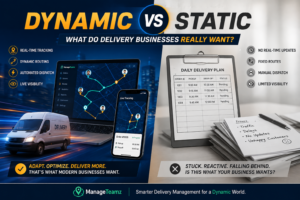
Dynamic versus Static: What Do Delivery Businesses Really Want?
As the person managing delivery, it seems pretty straightforward to plan a route to satisfy every customer.
It is much simpler to satisfy only one customer, though – and even more simple to provide food and other things to one customer at an expected time after he or she places an order.
A company has to optimize its delivery in order to maximize performance. Before technological advances, companies would use static routing, but the dynamic approach is much more flexible and can provide benefits to almost anyone looking to use it in their company.
Let us review both static and dynamic route planning and their benefits and decide which one is best in specific cases.
What Is Static Route Planning?
In the static approach, companies plan each delivery before the beginning of a day, and the drivers generally try to follow this plan as much as they can during the day.
As an example, let us take a local bakery that serves 5 regular customers. A couple can take their routine delivery of bread and other foods in the morning. So, the bakery prepares the address, delivery time, and expected traffic and sets up the delivery route accordingly. It is much easier for the driver to deliver to known clients every morning. Static routings are efficient and easy to plan when:
- Delivery locations tend not to change
- The delivery has consistent demands and does not require changes
- Delivery traffic is not really changed
- Delivery drivers are following the same routes throughout their work
- There are a rather limited number of delivery services.
- These are a few of the cases static routing is most suitable for.
There may be situations when the actual conditions do not follow the planned ones, which becomes a problem for the delivery companies – as well as their clients, who have to follow the scheduled deliveries.
A driver can have some late clients. He may also be waiting in traffic, and this can interfere with the delivery service and affect his work time.
Such conditions cannot be accounted for when making daily delivery plans with the previous day. A static way of planning is thus a great option when traffic and delivery demands are consistent but does not allow to make adjustments and changes in real time.
What Is Dynamic Route Planning?
The dynamic approach makes it quite simple to accommodate any client requirements in real time during deliveries. Instead of following the previously planned route, delivery drivers and the company plan new delivery itineraries on the basis of where delivery personnel are, the current traffic situation, and other factors that are relevant to the delivery, such as changes in their customers’ orders.
For instance, ten packages are waiting for the driver on the first part of his route.
Half of them have finished their delivery, when the driver gets a new high-priority client. Now it is necessary to choose between two options: driving back to a distant address to deliver this order or delivering it together with one of the last five packages to the other clients. A dynamic approach helps in solving this problem and gives directions in such case.
Static and Dynamic Route Planning: What Are the Differences?
To summarize, the main difference is the flexibility of the dynamic approach. Static routing plans the delivery itineraries and assumes that delivery drivers can meet every expectation.
Dynamic routing uses the information on the delivery vehicle’s location, order, deliveries that have already been made and other factors to make more optimal and effective delivery itineraries. The static approach plans delivery one day in advance.
It helps when deliveries rarely change, when routes do not differ much from day to day, and customers’ demands remain the same. The dynamic planning considers the current traffic and other conditions and helps to accommodate to the clients’ and delivery company’s different demands and make changes as one goes. Thus, they are more flexible and efficient, which will reduce the delivery time and optimize the delivery company performance on a daily basis.
Why Do Small Businesses Really Need Dynamic Routing?
One may think it is only large organizations that must optimize delivery and make changes daily; however, it is especially relevant for those who do not have many delivery drivers available.
Dynamic planning helps small companies accommodate to daily changes and make the best out of their current situation.
Small business owners can use a delivery tracking app for delivery services to help make those daily changes and help with optimization without losing much time and money.
Moreover, delivering products takes a considerable amount of fuel and money. Optimization of delivery routes and using the best way of transportation at a specific moment in time will help save a lot of resources both for delivery drivers and for the company itself.
The Customer Experience Should Be Taken Into Account, Too
While delivery companies tend to strive to make the fastest deliveries possible while spending the least amount of time and money on them, their clients also care about their delivery time.
It has become much easier to plan and track delivery thanks to the delivery GPS tracking application that helps keep updated with drivers’ changes. This way the clients will know when their item will be delivered and not worry about something going wrong with their delivery time schedule so that they can get what they ordered on time.
Does Dynamic Route Planner Replace Static Planning?
It is not required for delivery companies to choose one or the other exclusively.
The two above mentioned approaches can successfully work together, depending on specific instances.
A company can choose static plans at the beginning of the day and make some adjustments when the time for delivering arrives depending on the current delivery schedule and demands.
As mentioned above, both static and dynamic route planning can work together successfully.
In the case when a delivery company has a client with a regular delivery schedule, those deliveries will hardly change. In other cases, however, clients order different deliveries that may need to be planned differently. Static route is great for clients with scheduled delivery and regular demands. It makes sense to use a dynamic approach to make changes when those demands change.
Choosing the Static or Dynamic Approach: Which Is the Best?
There are two main types of the delivery routing solutions – the static and the dynamic ones.
Both can make the delivery process efficient and organized but have different indications as for when and how to use them.
The static approach is rather simple but not flexible, while the dynamic approach makes it possible to organize delivery according to the current traffic, time, and client demands.
The choice usually depends on the size of the business and the frequency of deliveries, as well as what kind of deliveries – regularly scheduled ones or same-day – the delivery company provides most often. Choosing to set up GPS delivery tracking app for small business, owners make the most out of their delivery possibilities and prepare for the day-to-day optimizing.
The Future of Delivery Routing Solutions
Delivery businesses have come a long way. Now it is much easier to plan the delivery routes and schedule deliveries in such a way that everyone benefits.
The delivery optimization software can effectively help in making delivery efficient, organized, timely, and up to the clients’ expectations. They can accommodate to both the drivers, whose main concern is getting to the delivery location in the shortest time in an efficient and safe way and the clients and their expectations and demands, including getting their orders on time. Using both static and dynamic delivery methods may become necessary as the company grows or as the demands and possibilities change.
In the future, delivery companies will no longer rely exclusively on the driver’s knowledge of the road. A tracking application for small business can use the current delivery data, including the delivery traffic, and other relevant aspects, such as delivery dispatch and tracking, to provide the necessary optimization and make delivery not only shorter but more efficient than ever before.
In fact it is not always the most short delivery that works – it can often be the one that takes into account most of the changes and requirements the delivery drivers and companies have.