If you are planning a food delivery marketplace, the first question is always the budget. Agencies quote five figures and several months for a custom build, while ready-made scripts promise a much faster start. This guide breaks down what an Uber Eats clone really costs, what the price includes, and where the extra spending usually hides.
What does an Uber Eats clone include?
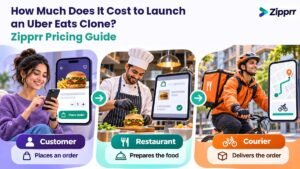
A working food delivery platform is not one app. It is four connected products that talk to each other in real time. The customer storefront lets people browse restaurants, build a cart and pay. The restaurant panel handles menus, order acceptance and preparation times. The driver panel manages delivery requests, navigation and earnings. The admin dashboard ties everything together with commissions, payouts, zones and reports.
Building all four from scratch is where custom quotes balloon. A ready-made script from Zipprr gives you these panels as finished software, so your budget goes into launching in your city instead of reinventing basic order flows.
Zipprr Uber Eats clone pricing
The Uber Eats clone script from Zipprr is sold as a one-time licence in two plans.
- Standard, $490 one-time: the complete web platform with customer, restaurant, driver and admin panels.
- Pro, $890 one-time: everything in Standard plus native iOS and Android apps for customers and drivers.
There is no monthly software fee and no per-order royalty. Zipprr is also running a Black Friday offer with up to 50% off, so it is worth checking the current price before you decide.
Which plan should you pick?
Choose Standard if you want to prove demand first. A mobile-friendly web storefront is enough to onboard your first restaurants, take real orders and learn what your city actually wants. Choose Pro if app-store presence is part of your pitch from day one, for example when you are targeting a market where customers expect to download an app before ordering.
Many founders start with Standard, validate a single neighbourhood, and upgrade once repeat orders prove the model. That keeps early risk low without closing any doors.
Costs the script price does not cover
A fair budget looks beyond the licence. Plan for these items so nothing surprises you after launch:
- Hosting and domain. A modest cloud server and a domain are usually enough while order volume is small.
- Payment gateway fees. Gateways charge a small percentage per transaction, which you recover through your commission model.
- Maps and SMS services. Maps, geolocation and notifications are billed by usage and stay low at the start.
- Restaurant and driver onboarding. This is the real growth cost: photographing menus, signing partners and recruiting your first drivers.
- Marketing. First-order discounts and local promotion decide how fast you reach repeat customers.
Custom build versus a ready-made script
A custom marketplace gives total freedom, but you pay for every screen, every API and every revision, and you wait months before the first order. A ready-made script flips that. You accept a proven structure, then customise branding, commission rules and service areas. For most first-time founders, the script route reaches a live product weeks earlier and costs a fraction of the custom quote.
How operators earn back the investment
Revenue in a food delivery marketplace usually comes from several streams working together: commission on every order, delivery fees, restaurant subscription or promotion fees, and small service charges. Even modest daily volume in one city can cover your hosting and onboarding costs, which is why a low upfront licence matters so much. The less you spend before the first order, the sooner the marketplace becomes self-funding.
A realistic first-month plan
In week one, brand the platform, set commission rates and configure your delivery zone. In week two, sign up ten to twenty local restaurants and load their menus. In week three, onboard drivers and run test orders end to end. In week four, launch with a first-order offer and track which restaurants bring repeat customers.
Growing beyond food delivery
Once food orders are steady, many operators expand into rides or other on-demand services using the same drivers and customer base. The Uber clone adds taxi booking, the Gojek clone bundles many services into one app, and the Eat24 clone suits a restaurant-first ordering model. Starting with food keeps the first launch focused, and expanding later keeps it affordable.
Frequently asked questions
Is the Uber Eats clone price a monthly fee? No. Both plans are one-time licences with no monthly software charge.
Can I add mobile apps later? Yes. You can begin on the web platform and move to the Pro plan when you are ready for iOS and Android apps.
Do I need a developer to launch? Not to get started. The panels are ready to use, and you can add customisation later if your model needs it.
Next step
If you want to see the four panels working before you spend anything, book a free demo with the Zipprr team and ask about the current Black Friday discount for your plan.