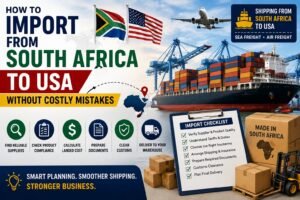
South Africa offers US businesses access to a diverse range of products, including automotive components, industrial equipment, agricultural goods, specialty foods, textiles, minerals, machinery, consumer products, and specialty manufactured items.
For many businesses, importing from South Africa can create valuable sourcing opportunities. However, international trade involves much more than finding a supplier and arranging transportation.
A successful shipment requires careful planning around supplier verification, product quality, US regulations, customs classification, tariffs, documentation, freight, insurance, and final delivery.
The good news is that most costly mistakes can be avoided.
The key is to understand the process before your goods leave South Africa.
This guide explains the essential steps for importing from South Africa and helps first-time importers understand how to manage shipping from South Africa to USA more effectively.
Step 1: Define Exactly What You Want to Import
Before contacting suppliers, get specific about the product you want to buy.
Avoid broad descriptions such as “South African products” or “industrial goods.” Instead, create a clear product specification that includes:
- Product name and model
- Materials and components
- Dimensions and weight
- Intended use
- Technical specifications
- Quality standards
- Packaging requirements
- Expected order quantity
- Target purchase price
- Target selling price
This step makes it easier to compare suppliers accurately.
For example, if you ask several companies to quote for a piece of machinery without detailed specifications, each supplier may offer a different version. One quotation may include additional features while another covers only the basic model.
A detailed specification helps you compare like with like and reduces misunderstandings later.
Step 2: Research the US Market Before Buying
A product may perform well in South Africa but have limited demand in the United States.
Before committing money, research the market.
Look at:
- Existing competitors
- Retail and wholesale prices
- Customer reviews
- Product features
- Seasonal demand
- Available alternatives
- Shipping and distribution costs
- Potential profit margins
Customer reviews can be particularly useful. Look for repeated complaints about existing products. Problems involving quality, design, packaging, durability, or usability may reveal an opportunity to offer something better.
However, do not assume that a high selling price automatically means high profits.
Your final costs may include international freight, customs duties, tariffs, insurance, warehousing, domestic delivery, returns, and other expenses.
The important question is not simply, “How much does this product sell for?”
Instead, ask:
“What will this product cost me when it is ready to sell in the United States?”
Step 3: Find and Compare South African Suppliers
Once you understand the product and market, start building a list of potential suppliers.
Do not automatically choose the first company that responds.
Compare several suppliers based on:
- Years in business
- Manufacturing location
- Production capacity
- Export experience
- Minimum order quantities
- Lead times
- Product specifications
- Quality-control procedures
- Certifications
- Packaging
- Payment terms
- Shipping terms
The lowest price does not always provide the best value.
One supplier may offer a lower unit price but require a large minimum order. Another may charge more but provide better quality control, shorter lead times, or greater experience exporting internationally.
Look at the entire business relationship rather than focusing only on the initial quotation.
Step 4: Verify the Supplier Before Sending Money
Supplier verification is one of the most important parts of importing from South Africa.
A professional website alone does not prove that a company is reliable.
Before placing a significant order, check:
- Business registration
- Physical address
- Manufacturing location
- Company history
- Product documentation
- Certifications
- Export experience
- Customer references
- Production capabilities
Ask whether the company manufactures the product itself or works as a trader.
Neither arrangement is automatically a problem, but you should understand who is actually responsible for production.
If possible, request photographs or videos of the manufacturing facility. For larger transactions, consider an independent inspection or factory audit.
The more you know about your supplier, the easier it becomes to identify potential risks before making a payment.
Step 5: Order a Sample Before Scaling
Never rely completely on photographs, product catalogs, or written descriptions.
Request a sample whenever practical.
Check the:
- Materials
- Construction
- Dimensions
- Product quality
- Function
- Durability
- Packaging
- Labeling
- Overall appearance
If the product has technical specifications, test them.
A sample may add cost and time to the process, but it is far less expensive than discovering a major quality problem after ordering a large shipment.
It is better to find a problem with one sample than with an entire container of inventory.
Step 6: Check US Import and Product Requirements
A product that is legally manufactured and sold in South Africa is not automatically approved for the US market.
Depending on the product, requirements may involve agencies responsible for food, consumer safety, environmental standards, agriculture, transportation, communications, or other regulated areas.
Certain products may require:
- Permits
- Testing
- Certifications
- Registrations
- Inspections
- Specific labeling
For example, food products may face different requirements from machinery. Electronics, children’s products, cosmetics, chemicals, and medical products can also involve product-specific rules.
Before placing an order, research the exact product.
Ask two important questions:
Can this product legally enter the United States?
Can this product legally be marketed and sold after it arrives?
Both questions matter.
Step 7: Determine the Correct HTS Classification
Commercial imports need the appropriate customs classification under the Harmonized Tariff Schedule of the United States.
The correct classification can depend on:
- Materials
- Product composition
- Function
- Design
- Manufacturing process
- Intended use
- Technical characteristics
The HTS classification can affect applicable duties, tariffs, quotas, and other import requirements.
Do not simply use a code provided by the supplier without verifying it for US customs purposes.
An incorrect classification can lead to delays, additional costs, or compliance problems.
If the classification is unclear, seek qualified customs guidance before the goods are shipped.
Step 8: Check Current Tariffs and Trade Treatment
Tariffs can have a major impact on whether an import is profitable.
One of the biggest mistakes importers make is relying on outdated information.
The duty treatment for a shipment depends on the specific product, its HTS classification, country-of-origin rules, and any trade measures in effect at the time of entry.
Before finalizing an order, check:
- HTS classification
- Current duty rates
- Additional tariffs, if applicable
- Antidumping or countervailing duties
- Quotas
- Current preferential treatment
- Country-of-origin requirements
Do not assume that every product from South Africa receives the same tariff treatment.
Always verify the current rules for the exact product you plan to import.
Step 9: Calculate the Complete Landed Cost
The supplier’s price is not your final cost.
Your real cost is the landed cost.
A basic landed-cost calculation may include:
Product cost + inland transportation + export charges + international freight + insurance + duties + tariffs + customs fees + port charges + domestic transportation + warehousing
You may also need to account for:
- Product testing
- Inspections
- Certifications
- Labeling
- Special packaging
- Storage
- Financing costs
- Customs examinations
- Demurrage or detention
Example
Suppose your supplier charges $30,000 for your goods.
You also pay:
- $2,000 for inland transportation
- $5,000 for ocean freight
- $800 for insurance
- $4,500 in duties and related charges
- $2,500 for US transportation and handling
Your approximate landed cost becomes $44,800.
That means the real acquisition cost is not $30,000.
Calculating landed cost before ordering helps you determine whether the product can generate a sustainable profit.
Step 10: Understand Your Incoterms
Your supplier may quote using Incoterms such as:
- EXW
- FCA
- FOB
- CIF
- DAP
- DDP
These terms help define the responsibilities of the buyer and seller.
Before accepting a quotation, understand:
- Who arranges pickup?
- Who handles export procedures?
- Who pays inland transportation?
- Who arranges international freight?
- Who provides insurance?
- When does risk transfer?
- Who handles import clearance?
- Who pays duties?
- Where does final delivery occur?
A low supplier price may exclude major costs that you expected to be included.
Always compare supplier quotations on the same basis.
Step 11: Choose the Right Shipping Method
The best method for shipping from South Africa to USA depends on the product, shipment size, budget, and delivery deadline.
Ocean Freight
Ocean freight often works well for:
- Large shipments
- Heavy products
- Machinery
- Palletized cargo
- Large inventory orders
It can provide a lower cost per unit, particularly for larger shipments. However, transit times are generally longer.
Air Freight
Air freight may be suitable for:
- Samples
- Small shipments
- Urgent inventory
- High-value products
- Replacement parts
It generally costs more but can significantly reduce transit time.
Do not choose transportation based only on the freight quotation.
Consider the total business impact.
A slower shipment may cost more in lost sales if it creates an inventory shortage.
Step 12: Prepare Your Documents Carefully
Accurate documentation helps prevent unnecessary delays.
Depending on the shipment, documents may include:
- Commercial invoice
- Packing list
- Bill of lading
- Air waybill
- Purchase order
- Product specifications
- Certificates
- Permits
- Country-of-origin information
- Product-specific documents
Make sure the information is consistent across all documents.
Pay close attention to:
- Product descriptions
- Quantity
- Value
- Weight
- Country of origin
- Buyer and seller information
- Shipping terms
Avoid vague descriptions such as “goods” when a specific product description is available.
Clear documentation makes the customs and transportation process easier to manage.
Step 13: Confirm the Country of Origin
The supplier’s location does not always determine the country of origin for customs purposes.
A product may be assembled in South Africa using components from other countries.
Depending on the product and applicable rules, origin may depend on where substantial manufacturing or transformation occurred.
Ask your supplier:
- Where was the product manufactured?
- Where were major components produced?
- Where did significant processing occur?
- What documents support the stated origin?
Accurate origin information is important for customs declarations and tariff treatment.
Never assume that a product qualifies for a particular trade preference simply because the supplier is based in South Africa.
Step 14: Consider Using a Customs Broker
A customs broker can assist with the import process, particularly for first-time importers.
A broker may help with:
- Customs entries
- Documentation
- Classification
- Duty calculations
- Customs bonds
- Filing requirements
However, the importer remains responsible for providing accurate information.
Do not treat a customs broker as a replacement for your own understanding of the shipment.
Review important details, including:
- Product description
- Classification
- Value
- Country of origin
Professional assistance can make the process easier, but informed importers are less likely to encounter avoidable problems.
Step 15: Consider Cargo Insurance
International cargo passes through several stages before reaching its final destination.
Risks can include:
- Damage
- Loss
- Theft
- Accidents
- Weather-related incidents
- Mishandling
Do not assume that the carrier automatically covers the full value of your shipment.
Consider cargo insurance based on the value of the goods, transportation method, route, packaging, and your ability to absorb a financial loss.
For high-value cargo, insurance can be an important part of your overall risk-management strategy.
Frequently Asked Questions
What products can I import from South Africa to the USA?
Businesses can import a wide range of products, including automotive components, industrial products, agricultural goods, specialty foods, machinery, textiles, minerals, and consumer goods. Requirements depend on the specific product.
Do I need a license to import from South Africa?
There is no universal import license for every product, but certain goods may require permits, registrations, certifications, or approvals from relevant US agencies.
How long does shipping from South Africa to USA take?
Transit times depend on the shipping method, origin, destination, carrier schedule, customs processing, and inland transportation. Air freight is generally faster, while ocean freight is often more economical for larger shipments.
How do I calculate landed cost?
Add the supplier’s product price to all relevant expenses, including inland transportation, international freight, insurance, duties, tariffs, customs-related charges, port costs, domestic delivery, and other applicable fees.
Should I use a customs broker?
A customs broker can assist with customs procedures and documentation, especially for first-time importers. However, the importer remains responsible for the accuracy and compliance of the shipment.
What is the biggest mistake first-time importers make?
One of the biggest mistakes is focusing only on the supplier’s price. Successful import planning requires calculating the complete landed cost and understanding all compliance and logistics requirements before placing the order.