Buyers researching brushed motors tend to ask the same handful of questions, whether they work in power tools, pumps or appliances. This article answers seven of them using the published MGLORY RS775 information, so you can walk into a supplier conversation prepared.
The Questions
Is the voltage fixed?
No. The name RS775 describes a frame family, not one electrical rating. MGLORY lists configurable voltage from 6 to 36 V, and the winding must match the supply. Speed, current and power depend on the winding and the load.
How big is it and what does it weigh?
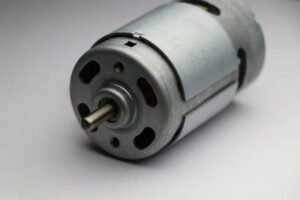
The body is about 42.2 mm in diameter and 66.5 mm long, with a 5 mm shaft, and it weighs approximately 360 g. Those are the published 775 motor dimensions, useful for early layout. A complete outline drawing should confirm mounting holes, terminals and shaft extension before you finalise a housing.
Can I run it in either direction?
Yes. Rotation is clockwise or counter-clockwise, and changing the polarity reverses it. Make sure your drawing states which direction applies to which polarity so everyone builds to the same specification.
How long will it last?
That depends on use. Brushed motors have carbon brushes and a mechanical commutator that wear as the motor runs. Frequent starts, high current, elevated temperature and long duty cycles shorten brush life. The guide gives no life figure, so ask your supplier what to expect for your duty and test samples to confirm.
Can the motor be customised?
MGLORY says it can evaluate custom voltage, speed, shaft, lead wire and connector requirements. Prepare a brief with your supply voltage, loaded speed, torque, duty, environment and quantity so the supplier can respond precisely.
Do I need a controller?
A brushed motor is a two-wire device with carbon-brush commutation, so it does not need commutation electronics. You may still want speed control or current protection. Changing voltage can influence speed, but current, torque and temperature must stay within tested limits.
When should I consider brushless instead?
The guide points to the BLDC-5015 brushless motor for long-life controlled equipment where lower brush wear and maintenance matter. In general, brushless designs need a drive circuit, so weigh that against the wear benefit.
Where Do I Find the Numbers?
Everything above should be backed by documents. Ask for the outline drawing, a representative performance curve and the rs775 datasheet for the winding you are considering. A good sheet states test and rated voltage, no-load and loaded figures, the maximum-efficiency point, stall values, winding resistance, ambient test temperature, duty cycle, rotation and tolerances.
What Should I Do Next?
Write down your working point: voltage, loaded speed, continuous and peak torque. Add duty, ambient temperature and space limits. Then request samples that match your application and test them under real load, measuring current and temperature rise. A sample that reaches the right no-load speed can still overheat or stall once it carries the real load.
A Note on Choosing Between Frames
If you are unsure whether the RS775 is the right size, compare it with its neighbours. The RS540 suits lighter, compact systems, the RS750 covers stronger mid-range loads, and the RS775 offers a larger frame for higher output and thermal capacity. Choose the smallest frame that meets your working point with margin.
Questions Worth Adding
Every project has its own extras. You might ask about noise limits, wire length, connector type, packaging, expected annual quantity or lead time. Put those in your first message so the reply can be complete.
Common Misunderstandings
Some beliefs keep appearing in inquiries. The first is that RS775 means one specification. It does not; it names a frame family. The second is that higher voltage always means higher output. The guide’s 18 V reference winding delivers 259 W, while its 24 V reference winding delivers 37 W, so the winding decides.
The third is that no-load speed is working speed, and the fourth is that stall torque is usable torque. Neither is true. Clearing these up before you write to a supplier saves a round of emails. It also builds mutual trust.
A Short Pre-Inquiry Check
Before you send a message, confirm that you can state your supply voltage, speed needed under load, continuous and peak torque, run time per cycle, startup frequency and ambient temperature. Add your airflow situation, shaft and mounting drawing, wire and connector needs, noise limits and annual quantity.
If you cannot answer one of these yet, say so. A supplier can often suggest how to measure it.
Conclusion
The seven questions come down to one habit: ask for specifics and test against your real load. Voltage depends on the winding, size comes from the drawing, life depends on duty and customisation depends on a clear brief. With those answers in hand, you can compare suppliers on facts.