
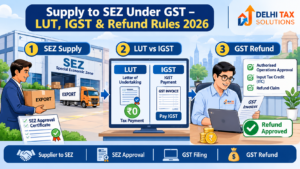
Supply to SEZ under GST is an important consideration for Indian manufacturers, exporters, service providers and businesses working with Special Economic Zone (SEZ) developers and units. The Integrated Goods and Services Tax (IGST) Act, 2017 provides zero-rated treatment for eligible supplies made for authorised operations. However, businesses must satisfy specific legal and documentation requirements before claiming this benefit. Understanding LUT filing, IGST treatment, Input Tax Credit and refund procedures can help suppliers avoid compliance errors and protect their working capital.
What Is Supply to SEZ Under GST?
A Special Economic Zone is a designated area established to promote investment, manufacturing, international trade and economic activity.
Under Section 16(1)(b) of the IGST Act, 2017, a supply of goods or services to an SEZ developer or unit for authorised operations qualifies as a zero-rated supply.
This treatment is different from an ordinary domestic supply. Eligible suppliers can access the GST refund mechanism under the applicable statutory conditions.
However, having an SEZ customer does not automatically make every transaction zero-rated. The supplier must verify whether the goods or services are intended for authorised operations.
Why Is an SEZ Supply Treated as Interstate?
Section 7(5)(b) of the IGST Act classifies supplies to or by an SEZ developer or unit as interstate supplies.
This classification applies even when the supplier and SEZ recipient are located in the same state.
For example, a software consultancy in Gurugram providing eligible services to an SEZ unit in Gurugram must consider the interstate classification under this provision.
Businesses should distinguish between two legal questions:
- Is the transaction an interstate supply?
- Does the transaction qualify as a zero-rated supply for authorised operations?
These questions involve separate provisions of the IGST Act.
How Does Zero-Rated Supply Work Under GST?
Zero-rated supply is different from an ordinary exempt supply.
Section 16(2) of the IGST Act permits eligible Input Tax Credit (ITC) on zero-rated supplies, subject to the restrictions under Section 17(5) of the CGST Act.
Section 16 provides different refund mechanisms for eligible zero-rated supplies.
1. Supply Without Payment of IGST Under LUT
Section 16(3) provides the Bond or Letter of Undertaking (LUT) route.
An eligible registered supplier can make a qualifying zero-rated supply without upfront payment of IGST by furnishing the prescribed Bond or LUT.
The supplier can subsequently claim a refund of eligible unutilised ITC under Section 54 of the CGST Act and the applicable GST Rules.
Registered suppliers generally furnish LUT through Form GST RFD-11.
This option is useful for businesses that prefer to avoid blocking working capital through upfront IGST payments.
2. Supply on Payment of IGST
Section 16(4) permits the Government to notify classes of persons and goods or services eligible to make zero-rated supplies on payment of IGST and claim a refund of the tax paid.
Notification No. 05/2023-Integrated Tax, dated 26 October 2023, covers qualifying suppliers making supplies to SEZ developers or units for authorised operations, subject to the notification’s exclusions.
Businesses must verify whether their particular supply falls within the permitted category before choosing this route.
Section 16(5) also restricts refunds relating to zero-rated supplies of goods that are subjected to export duty.
What Documents Are Required for SEZ GST Compliance?
Documentation plays a critical role in SEZ refund applications.
Suppliers should maintain:
- GST registration certificate and recipient GSTIN.
- SEZ approval and relevant authorisation details.
- Purchase orders and service agreements.
- Properly prepared GST invoices.
- Valid LUT acknowledgement, where applicable.
- Delivery challans and transportation records.
- Evidence of admission of goods into the SEZ.
- Evidence of receipt of services for authorised operations.
- Prescribed endorsement from the SEZ’s specified officer.
- GST return, ITC and refund reconciliation records.
Why Is the SEZ Officer’s Endorsement Important?
Rule 89 of the CGST Rules prescribes the evidence required for SEZ-related refund claims.
For supplies of goods, the supplier must apply after the goods have been admitted in full into the SEZ for authorised operations, as endorsed by the specified officer.
For services, the supplier must provide evidence of receipt of the services for authorised operations, supported by the relevant endorsement.
Service refund documentation also includes the prescribed invoice information and evidence of payment by the SEZ recipient.
Maintaining these documents from the beginning can prevent avoidable refund delays.
How Can Businesses Claim GST Refunds on SEZ Supplies?
Businesses should follow a structured refund process.
Step 1: Verify the SEZ recipient.
Check the recipient’s GSTIN, SEZ status and authorised-operations requirements.
Step 2: Prepare the GST invoice.
Ensure that the invoice includes the correct recipient information, supply description and applicable tax treatment.
Step 3: Select the permitted refund route.
Determine whether the LUT/Bond route or notified IGST-payment route is available.
Step 4: Complete GST return reporting.
Report the supplies accurately and reconcile the relevant outward supply information.
Step 5: Obtain the prescribed SEZ endorsement.
Collect evidence of receipt of goods or services for authorised operations.
Step 6: Reconcile ITC and outward supplies.
Verify the eligible refund amount against supporting financial and GST records.
Step 7: Submit the refund application.
File the applicable refund claim through Form GST RFD-01 under Section 54 of the CGST Act and the relevant refund rules.
Common Mistakes Businesses Should Avoid
SEZ suppliers can face compliance problems when they overlook legal or documentation requirements.
Common mistakes include:
- Treating every SEZ transaction as automatically zero-rated.
- Ignoring the authorised-operations condition.
- Applying incorrect GST classification.
- Using an invalid LUT.
- Reporting incorrect invoice information.
- Missing the prescribed SEZ endorsement.
- Filing incomplete refund applications.
- Failing to reconcile ITC and outward supplies.
A proper invoice review and documentation process can reduce these problems.
Quick Summary: Supply to SEZ Under GST
| Particular | Relevant provision |
|---|---|
| Zero-rated SEZ supply | Section 16(1)(b), IGST Act |
| Interstate classification | Section 7(5)(b), IGST Act |
| Input Tax Credit | Section 16(2), IGST Act |
| LUT/Bond route | Section 16(3), IGST Act |
| Notified IGST-payment route | Section 16(4), IGST Act |
| Export-duty restriction | Section 16(5), IGST Act |
| SEZ refund evidence | Rule 89, CGST Rules |
| Refund application | Form GST RFD-01 |
Frequently Asked Questions
1. Is supply to SEZ under GST zero-rated?
Yes. Section 16(1)(b) of the IGST Act treats supplies of goods or services to an SEZ developer or unit for authorised operations as zero-rated supplies. The supplier must satisfy the applicable statutory conditions and provide the prescribed documentation to obtain refund benefits.
2. Is supply to an SEZ in the same state treated as interstate?
Yes. Section 7(5)(b) of the IGST Act classifies supplies to or by an SEZ developer or unit as interstate supplies. The same-state location of the supplier and recipient does not change this classification.
3. Which form is used for LUT filing under GST?
Eligible registered suppliers generally furnish their Letter of Undertaking in Form GST RFD-11. This allows qualifying zero-rated supplies without upfront payment of IGST, subject to the applicable statutory requirements.
4. Which form is used for an SEZ GST refund?
Form GST RFD-01 is used for applicable refund claims. Supporting documents depend on the refund route and whether the transaction involves goods or services. The supplier must provide the prescribed evidence of receipt for authorised operations.
5. Is an SEZ officer’s endorsement necessary for a refund?
Yes. Rule 89 of the CGST Rules prescribes evidence of admission of goods or receipt of services for authorised operations, supported by endorsement from the SEZ’s specified officer.
Conclusion
Supply to SEZ under GST can offer valuable tax and working-capital benefits to eligible Indian businesses.
The most important requirements are authorised operations, correct GST treatment, appropriate LUT or IGST-payment eligibility and complete refund documentation.
Businesses should review their invoices, recipient details, ITC records and SEZ endorsements before filing refund applications.
For an additional explanation of the practical compliance requirements, read the Supply to SEZ Under GST guide.
Official legal reference: Integrated Goods and Services Tax Act, 2017 – India Code.
Disclaimer: This article is for general informational purposes and is not a substitute for personalised GST or legal advice. The correct treatment depends on the facts of each transaction and applicable law.
Author Bio: Delhi Tax Solutions publishes educational resources on GST, Indian taxation, business registration and regulatory compliance. Its content focuses on helping businesses and taxpayers understand practical tax requirements and statutory developments.


