Video has become one of the most effective ways to communicate, educate, entertain, and promote a brand. From Instagram Reels and YouTube videos to advertisements, corporate films, wedding videos, and short films, professionally edited video content is in demand across many industries. This has made video editing a valuable creative and career-oriented skill for students, freelancers, content creators, and working professionals.
A well-designed video editing course in Surat can help learners move beyond basic cutting and trimming and develop practical skills in storytelling, transitions, audio editing, color correction, motion graphics, and professional post-production workflows.
What Is Video Editing?
Video editing is the process of selecting, arranging, modifying, and enhancing recorded footage to create a finished video. It involves much more than joining clips together. An editor decides how footage should flow, where cuts should happen, how audio should be balanced, and how visual elements should support the story.
Modern editing workflows can include importing footage, organizing media, creating timelines, trimming clips, adding graphics and effects, improving audio, color correction, and exporting videos for different platforms. Adobe’s current learning resources similarly emphasize project setup, timeline editing, effects, audio, and other core editing workflows.
Why Learn Video Editing in Surat?
Surat has a growing creative, business, education, advertising, and digital-content ecosystem. Businesses increasingly use videos for social media marketing, product promotion, events, websites, and online campaigns.
For learners, this creates opportunities to develop practical skills that can be applied across different types of projects. Local discussions also show interest among aspiring Surat-based editors in internships, mentorship, content creation, and freelance opportunities.
A video editing course in Surat can be particularly useful if you want structured learning rather than depending entirely on random online tutorials.
Who Can Join a Video Editing Course?
A professional video editing training program can be suitable for:
- Students and graduates
- Beginners interested in creative careers
- YouTubers and content creators
- Instagram and social media creators
- Freelancers
- Digital marketing professionals
- Photographers and videographers
- Wedding and event professionals
- Small business owners
- Aspiring filmmakers
- Working professionals looking to add a creative skill
You do not necessarily need a filmmaking degree to start learning video editing. Practical experience, technical knowledge, creativity, and a strong portfolio can all contribute to developing a career in this field.
What Will You Learn in a Video Editing Course in Surat?
The exact syllabus varies between institutes, but a comprehensive video editing training course in Surat should ideally cover both fundamentals and practical projects.
1. Video Editing Fundamentals
Beginners should first understand:
- Video formats and resolutions
- Frame rates
- Aspect ratios
- Timeline and sequence management
- Importing and organizing footage
- Cutting and trimming
- Basic transitions
- Video export settings
These fundamentals provide the foundation for more advanced editing techniques.
2. Adobe Premiere Pro
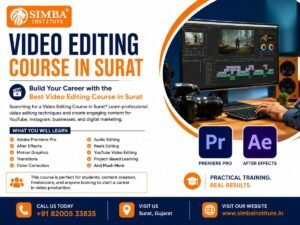
Adobe Premiere Pro is widely used for professional video editing. Students can learn how to organize footage, create sequences, edit clips, work with audio, apply effects, and prepare videos for different platforms.
Adobe also offers a professional certification pathway for digital video using Premiere, making software proficiency a useful addition to a video editor’s portfolio.
3. Motion Graphics and Visual Effects
Modern videos often require more than conventional editing. A quality course may introduce learners to:
- Motion graphics
- Animated titles
- Lower thirds
- Logo animation
- Text effects
- Visual effects
- Green-screen techniques
- Basic compositing
These skills can be especially useful for advertisements, social media videos, YouTube content, and promotional campaigns.
4. Color Correction and Color Grading
Color can significantly influence the appearance and mood of a video. Students can learn the difference between correcting footage and creatively grading it.
Important concepts include:
- Exposure
- White balance
- Contrast
- Skin tones
- Color consistency
- Creative looks
- Cinematic color grading
5. Audio Editing
Good visuals can lose their impact when audio quality is poor. Video editing training should therefore include:
- Dialogue editing
- Noise reduction
- Music placement
- Sound effects
- Audio transitions
- Volume balancing
- Voice-over synchronization
6. Social Media Video Editing
Short-form video has created a strong need for editors who understand platform-specific content. Training can include editing for:
- Instagram Reels
- YouTube Shorts
- YouTube videos
- Facebook videos
- Promotional videos
- Product videos
A good editor should understand pacing, hooks, subtitles, visual storytelling, and different aspect ratios rather than simply exporting the same video everywhere.
Career Opportunities After Video Editing Training
Completing a video editing course in Surat does not guarantee employment, but it can provide practical skills that support several career paths.
Possible roles include:
- Video Editor
- Junior Video Editor
- Social Media Video Editor
- YouTube Video Editor
- Motion Graphics Designer
- Post-Production Assistant
- Freelance Video Editor
- Content Creator
- Video Production Assistant
- Advertising Video Editor
Adobe recommends building a portfolio, gaining practical experience, developing software expertise, and networking as important steps toward becoming a video editor.
Why Practical Projects Matter
Watching tutorials is useful, but creating actual projects is essential. A strong course should give learners opportunities to work with raw footage and complete videos from beginning to end.
For example, students could create:
- A YouTube video
- An Instagram Reel
- A product advertisement
- A cinematic montage
- A wedding/event highlight
- A short promotional video
- A talking-head video
These projects can eventually become part of a professional video editing portfolio.
How to Choose the Best Video Editing Course in Surat
Before enrolling, compare courses based on the actual learning experience rather than only promotional claims.
Look for:
Practical training: Make sure the course includes hands-on editing projects.
Software training: Check which professional editing tools are included.
Updated curriculum: Video production tools and workflows continue to evolve, so the syllabus should remain current.
Portfolio development: A course that helps you create multiple finished projects can be more valuable than one focused only on theory.
Trainer experience: Experienced instructors can provide practical guidance on editing workflows and industry expectations.
Course duration and schedule: Choose a program that fits your availability and learning goals.
Certification: A certificate can demonstrate course completion, although your portfolio and actual editing ability remain important.
Video Editing as a Freelancing Skill
Video editing can also be developed as a freelance service. Beginners can start by creating sample projects and gradually build a portfolio.
Potential clients may include:
- YouTubers
- Influencers
- Digital marketing agencies
- Local businesses
- Wedding photographers
- Event companies
- Coaches and educators
- E-commerce brands
- Startups
The most important objective is to demonstrate what you can produce. A portfolio containing several strong examples can make it easier to communicate your skills to potential clients.
The Future of Video Editing
Video editing is also evolving with AI-assisted creative workflows. Automation can help with certain repetitive tasks, but editors still need creative judgment, storytelling ability, visual awareness, and attention to detail.
Adobe identifies communication, visual skills, attention to detail, understanding current trends, software proficiency, and portfolio development among important capabilities for video editors.
Therefore, the most valuable approach is not simply learning software buttons. It is learning how to tell a story through video while using modern editing technology efficiently.
Conclusion
A video editing course in Surat can be a practical starting point for anyone interested in filmmaking, social media, digital marketing, YouTube, advertising, or freelance creative work. The right training should combine editing fundamentals with professional software, audio, color, motion graphics, storytelling, and hands-on projects.
Whether you are a complete beginner or already creating videos, developing structured editing skills and building a strong portfolio can help you progress toward professional opportunities.
Frequently Asked Questions (FAQs)
1. What is a video editing course in Surat?
A video editing course in Surat is a structured training program that teaches learners how to edit, enhance, and produce professional videos using editing software and practical post-production techniques.
2. Who can join a video editing course?
Students, graduates, beginners, freelancers, YouTubers, content creators, photographers, marketers, and working professionals can learn video editing.
3. What software is taught in video editing courses?
Depending on the institute, training may include Adobe Premiere Pro, After Effects, DaVinci Resolve, or other video and motion graphics applications.
4. Is video editing a good career option?
Video editing can be a useful career skill for people interested in media, advertising, digital marketing, filmmaking, social media, YouTube, and freelance work.
5. Can beginners learn video editing?
Yes. Beginners can start with fundamental concepts such as cutting, trimming, transitions, audio, timeline management, and gradually progress to advanced editing.
6. How long does it take to learn video editing?
The time required depends on the learner’s starting level, practice routine, course structure, and desired specialization. Regular hands-on practice can accelerate skill development.
7. Is certification necessary to become a video editor?
Certification is not always mandatory. A strong portfolio demonstrating practical editing ability can be particularly important when applying for jobs or freelance projects.
8. Can I become a freelance video editor after training?
Yes. After developing sufficient skills, you can create a portfolio and offer editing services to creators, businesses, agencies, and other clients.
9. What should I look for in the best video editing course in Surat?
Look for practical projects, experienced trainers, updated software training, portfolio development, suitable class schedules, and a curriculum covering editing, audio, color, motion graphics, and storytelling.
10. Can video editing be learned for social media content?
Yes. Video editing courses can teach skills applicable to YouTube videos, Instagram Reels, Shorts, advertisements, promotional videos, and other digital content.