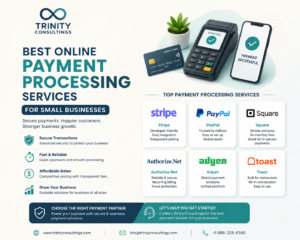
Choosing the right payment processing service can make a major difference for a small business. A good solution should make it easy for customers to pay while keeping processing costs, security risks, and account management under control.
However, the best option is not the same for every business. An online retailer may need a simple checkout system, while a subscription company may require recurring billing. Businesses in higher-risk industries may need specialized payment solutions that are different from standard providers.
If you are comparing a small payment processor, it is important to look beyond transaction rates and consider the complete payment setup.
What Makes a Payment Processing Service a Good Choice?
The right payment processor should fit your business rather than simply offer the lowest advertised fee. Several factors can help you compare your options.
Clear and Predictable Pricing
Processing fees are one of the first things small businesses consider, but the advertised transaction rate is not always the complete cost.
Depending on the provider, you may pay transaction fees, monthly charges, payment gateway fees, chargeback fees, or other account-related costs.
Before signing up, review the complete pricing structure and estimate what you would actually pay based on your monthly sales and average transaction size.
Convenient Payment Options
Customers may want to pay using credit cards, debit cards, digital wallets, ACH transfers, or other payment methods.
A processor that supports the methods your customers prefer can create a smoother checkout experience and give your business more flexibility.
Strong Security and Fraud Protection
Payment security is essential for any business accepting online transactions. Your payment solution should provide appropriate security measures and support applicable payment-card compliance requirements.
Fraud detection and chargeback management tools can also help reduce unnecessary losses and protect your business as transaction volume increases.
Easy Business Integration
The payment system should work with the tools you already use.
Depending on your business, you may need integration with an ecommerce website, accounting platform, CRM, invoicing software, subscription system, or point-of-sale solution.
Better integration can reduce manual work and make it easier to track payments and manage customer transactions.
Which Payment Processing Solution Fits Your Business?
Different businesses have different payment requirements. Instead of searching for one universal “best” processor, consider which type of solution matches your operations.
Simple Online Payment Processing
Small service businesses and online sellers with straightforward payment needs may benefit from an easy-to-use payment processor with simple pricing and quick integration.
This type of solution can be suitable when the business primarily accepts standard card payments and does not have unusual transaction patterns or complex billing requirements.
Ecommerce Payment Processing
Online stores often need more than basic card acceptance. They may require website integration, digital wallets, fraud protection, refunds, customer payment management, and detailed transaction reporting.
If you operate an ecommerce business, make sure the processor works with your shopping platform and provides the payment features your customers expect.
Recurring and Subscription Payments
Businesses that charge customers on a recurring basis need payment infrastructure that can manage scheduled transactions.
Subscription software, membership businesses, SaaS companies, and other recurring-revenue models should look for support for recurring billing, failed-payment management, and customer payment updates.
Specialized High-Risk Payment Processing
Some businesses may have difficulty obtaining standard payment processing because of their industry, transaction patterns, chargeback exposure, or other risk factors.
In these situations, a high risk merchant account may provide a more appropriate solution.
When Do You Need a High Risk Merchant Account?
A high-risk merchant account is designed for businesses that payment providers or acquiring banks consider to have elevated financial or operational risk.
Factors that can contribute to a high-risk classification may include:
- Higher chargeback rates
- Recurring billing models
- Large transaction amounts
- International transactions
- Industry-specific risks
- Longer fulfillment periods
- Limited business history
Being classified as high risk does not mean a business cannot accept online payments. It means the business may need different underwriting, pricing, reserves, or account requirements.
If your business falls into a higher-risk category, choosing a provider experienced with your type of business can be more important than simply choosing the lowest advertised rate.
Why the Payment Gateway Matters
A payment gateway is the technology that securely transmits payment information during an online transaction.
For businesses with specialized processing requirements, a high risk payment gateway may need to work with the appropriate merchant account and processor.
When evaluating a gateway, consider its security, payment-method support, fraud controls, recurring billing capabilities, integrations, reporting, and compatibility with your website or business software.
The gateway and merchant account serve different functions, but they need to work together for transactions to be processed successfully.
What Should You Compare Before Choosing a Small Payment Processor?
Once you understand your business requirements, compare providers using practical criteria rather than marketing claims.
Start with your expected monthly processing volume and average transaction value. Then consider the total processing cost, available payment methods, contract terms, chargeback policies, customer support, and integration options.
Also ask whether the provider can support your business as it grows. Switching payment systems later can require technical changes, account migration, and customer communication, so choosing a scalable solution from the beginning can save time.
For higher-risk businesses, also review underwriting requirements and whether the provider has experience supporting similar businesses.
How Can Small Businesses Choose the Best Option?
The best online payment processing service is ultimately the one that balances cost, reliability, security, features, and business requirements.
A small business with straightforward transactions may need a simple processor with easy setup and predictable pricing. An ecommerce business may prioritize website integration and fraud protection. A subscription company may require strong recurring billing capabilities. A higher-risk business may need a specialized high risk merchant account and compatible high risk payment gateway.
Before making a decision, calculate your expected processing costs and compare the complete service rather than focusing on one fee.
Final Thoughts
Finding the best online payment processing service starts with understanding what your business actually needs. Pricing matters, but security, payment methods, integrations, support, and scalability can be equally important.
A reliable small payment processor should make it easier to accept payments without creating unnecessary costs or operational problems. Businesses with more complex risk profiles should also consider whether specialized high-risk processing is more appropriate than standard payment services.
If you need help evaluating payment processing options for your business, Trinity Consultings can help you understand the available solutions and identify an approach that fits your payment requirements, business model, and growth plans. Contact Trinity Consultings to explore your payment processing options.