In the modern home, we obsess over the purity of our drinking water and the nutritional value of our food. Yet, the air we breathe—the very element that sustains us every second of every day—is often ignored. With increasing awareness of respiratory issues, volatile organic compounds (VOCs), and the lingering threat of mold, indoor air quality testing has shifted from a luxury to a necessity.
However, before you book a professional or buy a device, the most common question is always about the bottom line. How much does it actually cost to test your air? The answer isn’t a simple flat rate. In 2026, the cost of indoor air quality testing varies wildly based on what you are testing for, who you hire, and the size of your property.
Here is your complete, up-to-date pricing breakdown for 2026 to help you budget accurately.
The Baseline: What Drives the Price?
It is impossible to quote a single price for “testing the air” because air is a carrier for many different contaminants. A basic assessment is different from a comprehensive lab analysis. Before you panic at a quote, understand that the price is determined by the scope of the test—specifically, whether you are testing for particles, gases, or biological growth.
Option 1: The “Do It Yourself” Route (The Budget Sweep)
Cost: $30 – $150
For the budget-conscious homeowner, DIY test kits are the entry point. You can find these at hardware stores or online. They typically come in two forms:
- Petri Dish Tests ($30-$60): These are basic settle plates used primarily for mold. You open them, leave them out for a few hours, and send them to a lab.
- Comprehensive Snapshot Kits ($80-$150): These include multiple vials for different contaminants (mold, bacteria, and sometimes radon).
The Catch: While the upfront cost is low, the lab analysis fee is often separate. The $40 kit you buy might require a $50 lab fee to interpret the results. Furthermore, DIY results are often vague. A lab might confirm you have “Penicillium/Aspergillus” but cannot tell you the source or the severity levels in different rooms.
Best For: Initial screening and peace of mind. If your DIY test comes back clean, you are done. If it comes back dirty, you will need to escalate to a professional.
Option 2: Professional Mold and Allergen Testing
Cost: $200 – $450
This is the most common request for indoor air quality testing. If you smell musty odors or see visible water stains, this is the route to take.
- The Process: A certified inspector will conduct a visual assessment, then use a pump to pull a specific volume of air through a cassette to capture spores. They will take a “control” sample from outside your home to compare the spore counts against.
- What you pay for: The inspector’s expertise in locating the source, the equipment calibration, and the lab analysis (which gives you a spore trap report).
- Pricing Breakdown: In 2026, expect to pay a base fee of $150 to $200 for the first sample. Every additional room sampled will cost between $40 and $75.
The Reality Check: If the inspector finds mold, they will often charge extra for “surface sampling” (swabbing) to identify the specific species, adding another $50-$100.
Option 3: The Comprehensive Chemical & VOC Screening
Cost: $400 – $1,200
If you live near an industrial area, recently renovated, or suffer from chemical sensitivities, particle testing isn’t enough. You need to test for VOCs (formaldehyde, benzene, etc.).
This is significantly more expensive because it requires specialized equipment like a Photoionization Detector (PID) or laboratory-grade sorbent tubes. The inspector must send these tubes to an environmental lab, which uses mass spectrometry to identify chemical compounds down to the parts-per-billion level.
Pricing Breakdown: The base inspection fee usually starts at $400. Each individual test for a specific chemical class can cost $100-$200. If you want a “Total VOC” scan covering the whole house, you are looking at the higher end of this range.
Option 4: The Radon Test (Specialty)
Cost: $150 – $300 (Short-Term) / $200 – $500 (Long-Term)
Radon is a radioactive gas that causes lung cancer, and it requires a different method of testing. You cannot detect it with a general VOC test.
- Short-Term (2-7 days): A charcoal canister or continuous monitor is placed in the lowest living level of your home. This is usually included in real estate transactions. The cost includes the device, shipping, and lab analysis.
- Long-Term (90+ days): This is more accurate for seasonal variations and uses alpha-track detectors.
The Hidden Costs: What Most Guides Don’t Tell You
When budgeting for indoor air quality testing in 2026, keep these hidden variables in mind:
- HVAC Inspection: If your HVAC system is the source of the problem, inspectors will often charge a separate fee (around $100) to inspect the ductwork.
- Follow-up Testing: After remediation (removal of mold, etc.), you must have a “post-remediation verification” test. This is rarely included in the initial price and costs 50-75% of the original test.
- Rush Fees: If you are in the middle of a real estate closing, you may pay a 20% premium to get results within 24 hours.
The Real-Time Monitoring Alternative: The Smart Financial Choice
Here is the hard truth about professional testing: It is a snapshot in time. The air quality on a rainy Tuesday afternoon will be different from a dry Saturday. The air quality during a family dinner (with gas cooking) will differ from an empty house at 3:00 AM.
If you spend $400 on a professional test and discover a problem, you have to spend more to fix it, and then more to re-test. If you don’t have a visible problem, you are essentially paying for a one-time “all-clear.”
In 2026, the smartest way to spend your money for ongoing peace of mind is hybrid monitoring.
Rather than just relying on a one-off lab test, savvy homeowners are investing in real-time detection devices. This allows you to monitor fluctuations all year long, knowing exactly when to call a professional for a confirmatory lab test. This saves you from spending hundreds of dollars on a test during a “clean” season.
Why You Should Consider the Tilswall Air Quality Monitor
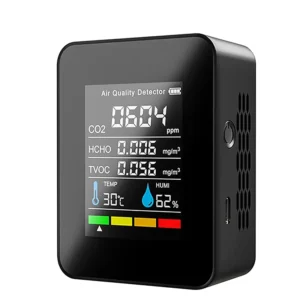
If you are looking for a way to get a continuous handle on your environment without breaking the bank, the Tilswall Air Quality Monitor is the essential tool for your arsenal.
Instead of waiting for a lab report weeks later, the Tilswall gives you immediate, highly accurate feedback on the four most critical indicators of indoor health:
- PM2.5 & PM10: It detects fine particulate matter—dust, smoke, and pet dander—in real-time, displaying the data on a clear, vibrant screen. This immediately alerts you to cooking smoke or dust spikes that a professional test would miss.
- Formaldehyde (HCHO) & TVOC: This device detects dangerous invisible gases that off-gas from new furniture, paints, and cleaning products. This is a specific benefit because professional VOC testing is the most expensive type of lab test—yet the Tilswall covers it continuously for a fraction of the cost.
- Temperature & Humidity: It monitors the environment to help you prevent the conditions that lead to mold growth in the first place.
While a $300 professional test tells you if something was wrong yesterday, the Tilswall Air Quality Monitor tells you what is happening right now. It empowers you to fix a spike immediately—by opening a window or turning on a purifier—saving you the expensive remediation costs down the line.
If you are serious about your health, don’t rely on a single expensive appointment. Use the Tilswall as your daily sentinel, and save your money for professional lab testing only when the real-time data suggests there is a complex problem to solve.
Check out the Tilswall Air Quality Monitor Today to start breathing cleaner, smarter air in 2026.