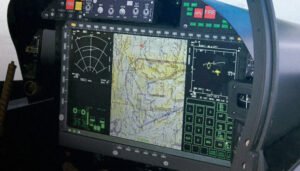
The word rugged appears on a lot of product data sheets, but a genuine rugged touch screen display for military, aerospace, or naval use has to meet a specific, testable set of criteria rather than simply survive being dropped once in a lab. Here is what actually separates a rugged touch display from a reinforced commercial panel.
Environmental Sealing
Ruggedization starts with sealing against moisture, dust, and fluid ingress, typically rated to an IP or MIL-STD-810 standard appropriate to the platform. Optical bonding, which fuses the cover glass, touch sensor, and display panel into a single sealed unit without an air gap, is central to this, since an unsealed air gap is where condensation forms and where dust and moisture eventually degrade image quality and touch accuracy.
Shock, Vibration, and Mechanical Durability
A rugged touch screen has to remain fully functional after sustained exposure to the shock and vibration profiles defined in MIL-STD-810, which vary depending on whether the display sits in a fixed wing cockpit, a helicopter subject to rotor induced vibration, or an armored vehicle traveling over rough terrain. The bezel, mounting hardware, and internal component attachment all have to be engineered together, since a display that passes vibration testing as a bare panel can still fail once installed in a real mounting configuration.
Touch Accuracy Under Real Operating Conditions
Touch technology intended for gloved operation, wet fingers, or continuous vibration needs calibration well beyond what a consumer touch screen requires. Both projected capacitive and resistive touch technologies are used across defense platforms, chosen based on glove thickness requirements, precision needs, and exposure to contaminants such as fuel or hydraulic fluid.
Electromagnetic Compatibility
A display mounted near radios, radar systems, or weapons electronics has to neither emit interference nor be disrupted by the interference around it, which is verified through MIL-STD-461 electromagnetic compatibility testing. This requirement is easy to overlook on a data sheet but frequently causes late stage integration problems when a display has not actually been qualified alongside representative avionics.
Thermal Management
Sealed enclosures that keep out moisture and dust also trap heat, which means a rugged touch screen display needs a thermal management strategy built into the mechanical design rather than relying on open air convection the way a commercial monitor does. Heat sinking through the bezel, careful component placement, and derating of internal electronics all help ensure the display continues operating reliably at the high end of its temperature range without the touch sensor or backlight degrading prematurely.
Night Vision Compatible Lighting
For military applications, the display’s backlight and any indicator lighting have to comply with Night Vision Imaging System standards so the panel does not create a detectable light signature or wash out night vision goggles. This typically requires purpose built LED backlighting and filtering rather than a simple brightness reduction on a standard commercial panel. Aeromaoz is a case in point. With more than 45 years of experience, the company designs and manufactures rugged HMI solutions for military and commercial aviation, armored vehicles, UAVs, flight simulators, and naval platforms, supplying Tier 1 system integrators and platform manufacturers worldwide.
When all of these elements are engineered together rather than added as an afterthought, the result is a touch screen that keeps performing exactly the same way on day one and after a decade of field use, which is ultimately the entire point of calling a display rugged. Buyers who ask for evidence behind each of these criteria, rather than accepting the word rugged at face value, are far less likely to be surprised later in a program.