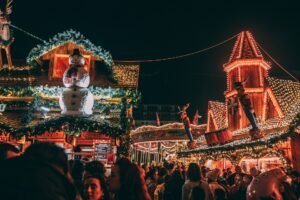
There is something about a European Christmas market that feels different from ordinary seasonal shopping. It may begin with a row of wooden stalls, warm lights glowing against the winter darkness, or the familiar scent of baked treats drifting through a historic square. Yet the real character of a Christmas market comes from something deeper: the traditions, crafts, foods, stories, and local details that have developed around it over generations.
That is why Dresden does not feel quite like Strasbourg, Strasbourg does not feel like Vienna, and Vienna has a character of its own. Each market carries a piece of the place where it grew.
Dresden: A Market Shaped by Centuries of Tradition
Dresden’s Striezelmarkt is one of the oldest continuously established Christmas markets in Europe, with its first documented appearance dating to 1434. Its origins were surprisingly practical. The original market was a one-day event where people could buy meat for the Christmas feast after the Advent fasting period. Over time, it developed into the Christmas market associated with Dresden today.
Its identity is closely connected with Saxony’s traditional crafts and festive foods. Even the name Striezelmarkt comes from Striezel, an old term connected with the pastry that developed into the famous Dresden Christstollen.
But what makes Dresden memorable is not simply its age. It is the feeling that traditional craftsmanship still has a visible place in the celebration. Wooden decorations, Erzgebirge folk art, candle arches, pyramids, and handmade seasonal objects give the market a distinctly handcrafted character.
It feels less like a temporary Christmas attraction and more like a tradition that has been repeatedly renewed.
Strasbourg: Christmas with an Alsatian Identity
Strasbourg brings a different atmosphere. Its Christmas market tradition dates back to 1570, when the city’s market became associated with the Christkindelsmärik tradition.
What makes Strasbourg special is the way Christmas becomes part of the architecture and identity of the city itself. The historic streets, decorated buildings, illuminated squares, and Alsatian traditions create an atmosphere that feels almost theatrical without needing to be artificial.
The market is closely connected with local food, regional crafts, festive decorations, and the traditions of Alsace. Rather than being simply a collection of stalls, it becomes part of the visual personality of the city.
Strasbourg shows how a Christmas market can become a kind of cultural portrait: you are not only seeing Christmas decorations, but also seeing how a particular region celebrates the season.
Vienna: Elegance, Music, and Imperial Surroundings
Vienna offers another interpretation of the Christmas market tradition. The city’s winter markets are surrounded by grand architecture, historic squares, music, lights, and an atmosphere that naturally feels more elegant.
Vienna is sometimes described as having one of Europe’s oldest Christmas-market traditions, with December markets documented as far back as the late thirteenth century. However, these early markets were broader December fairs rather than Christmas markets in the modern sense, so comparisons about which European market is truly “the oldest” can be misleading.
What makes Vienna distinctive is therefore not simply age. It is the combination of seasonal tradition with the city’s particular sense of elegance. Christmas here can feel grand without losing its warmth: glowing lights against historic buildings, handmade decorations, seasonal foods, music, and the familiar rhythm of Advent.
Nuremberg: Tradition with a Strong Local Character
Nuremberg’s Christkindlesmarkt has another personality. Its documented history reaches back to at least 1628, and the market has become strongly associated with traditional Franconian Christmas culture.
Its identity comes from recognizable local products and crafts rather than simply from decoration. Traditional gingerbread, handmade ornaments, and the famous Zwetschgenmännle figurines give the market details that belong specifically to Nuremberg.
That local character is important. A memorable Christmas market does not need to offer everything. Sometimes it becomes special because it protects a smaller collection of traditions and allows them to remain recognizable year after year.
Cologne: Christmas Beneath a Famous Landmark
Cologne offers yet another variation. Its best-known market is closely associated with the city’s cathedral, creating a dramatic setting in which the architecture becomes part of the Christmas experience.
Here, the market demonstrates another reason European Christmas markets remain so appealing: the surroundings matter almost as much as the stalls themselves. A decorated square, an old cathedral, a historic street, or a centuries-old building can transform ordinary seasonal objects into something emotionally memorable.
The lights and decorations do not exist separately from the city. They become part of it.
Prague, Vienna, Strasbourg, Dresden — Different Places, One Feeling
Across Europe, Christmas markets share familiar ingredients: lights, handmade goods, seasonal food, music, decorations, and the anticipation of Christmas. Yet their emotional character comes from local traditions.
Dresden feels deeply connected to craftsmanship and centuries of continuity. Strasbourg carries the atmosphere of Alsace and its distinctive cultural heritage. Vienna adds elegance, music, and historic grandeur. Nuremberg emphasizes recognizable local traditions and handmade products. Cologne demonstrates how architecture can become part of the celebration.
This is what makes European Christmas markets more than collections of decorated stalls.
They create a temporary world where ordinary winter streets become places of memory. People gather around familiar traditions, choose handmade objects, taste foods associated with the season, and bring small pieces of the atmosphere back into their homes.
That connection with handmade objects is perhaps one of the most enduring parts of the experience. A mass-produced decoration can be beautiful, but a handcrafted ornament carries another kind of meaning. It reflects time, patience, skill, and the person who made it.
The same feeling lies behind Crochet Cozy Moments and its approach to Handmade Crochet Christmas Ornaments. A Christmas ornament does not have to be large or elaborate to become meaningful. Sometimes a delicate handmade piece becomes special simply because it returns to the Christmas tree year after year.
European Christmas markets remind us that holiday decoration is not only about making a space look festive. It is about creating an atmosphere that feels personal.
And perhaps that is why these markets continue to inspire people long after the lights are gone: each one offers its own version of Christmas, shaped by the traditions of a particular place, yet familiar enough to feel like home.
Warmth in Every Stitch.