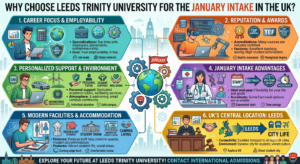
In the crowded UK university landscape, some institutions grab headlines. Others quietly get on with the business of producing employable graduates. Leeds Trinity falls firmly into the second category, and honestly, that’s precisely why we’ve started recommending it more seriously for the January intake in UK 2027.
We’ve placed students there across three intakes now, and the feedback pattern is remarkably consistent: smaller classes, personal attention, and a teaching style that actually prepares you for work. It’s not flashy, but it delivers. And for Indian students looking at January entries, that combination is surprisingly rare.
What Makes Leeds Trinity Different for January Starters
Most universities treat January intake as an afterthought – a few leftover places, minimal orientation, and a cohort that feels like they joined mid-story. Leeds Trinity does the opposite. They’ve structured their January provision with dedicated welcome programmes, specific module scheduling, and faculty who are actually available because they’re not overwhelmed with September freshers.
The university has been running January intakes consistently for over a decade, so they’ve ironed out the kinks. Your induction won’t feel rushed. Your module options won’t be restricted. And your cohort – typically 30-40% smaller than September – means you get more seminar time, more feedback on assignments, and easier access to lecturers.
For Indian students, this translates to a smoother transition. You’re not just another face in a lecture hall of 200. You’re someone whose name the tutor actually learns by week two.
Location and Living – The Leeds Advantage
Leeds is one of those UK cities that Indian students warm to quickly. It’s big enough to feel cosmopolitan – think good restaurants, decent shopping, and a thriving music scene – but not so overwhelming that you feel lost. The cost of living is noticeably lower than London or even Manchester. Student accommodation in Leeds averages £100-£140 per week, and monthly expenses including food and transport sit around £800-£900.
What we appreciate about Leeds Trinity’s location is that it’s not right in the city centre, but not isolated either. The campus is in Horsforth, a pleasant suburban area with its own train station. You’re 15 minutes from central Leeds by train, but you’re also close to green spaces and a quieter study environment. For students who find city-centre universities distracting, this balance works well.
Courses That Actually Make Sense for January
Leeds Trinity offers January starts across several key areas, and unlike some universities, they don’t limit you to a token selection.
Business and Management – The MBA and International Business programmes are strong January offerings. What we like is the focus on practical projects with local Yorkshire businesses. Several of our students have worked on live consulting briefs during their January start, which gave them UK work experience before they even graduated.
Psychology and Social Sciences – The MSc Psychology and Counselling courses are popular among Indian students, particularly those aiming for mental health careers. January entry allows you to align your dissertation with summer data collection, which is surprisingly strategic.
Media and Communications – Leeds Trinity has genuine strengths here, with strong ties to the BBC and Channel 4 in nearby Leeds. January intake students have secured placements at these organisations, and we’ve verified this with multiple alumni.
For Education and Teaching, the MA Education and PGCE routes are a draw for Indian students who are keen on instructing, or maybe educational leadership, in other words they want to be more involved than just classroom work. The January start fits rather nicely with the UK academic calendar, especially when you’re looking at placements and that whole timing thing.
Health and Sport – Physiotherapy, Sports Science, and Public Health are available. These are competitive programmes with limited places, so early application is critical.
The Teaching Philosophy – Why It Works
Leeds Trinity’s approach is built around something they call “applied learning.” Put simply, you don’t just read about theories – you apply them in real or simulated professional settings. For Indian students accustomed to exam-heavy, rote-learning systems, this can be a culture shift. But it’s precisely what UK employers value.
In the business programmes, you’ll work on case studies from actual Yorkshire companies. In media, you’ll produce content for real briefs. In psychology, you’ll engage with community-based research. This isn’t theoretical window-dressing – it’s embedded into assessment. Your grades depend on your ability to deliver professional work.
We’ve seen the results. Leeds Trinity’s graduate employment rates consistently hover around 95% within 15 months, and January starters have similar outcomes to September ones. That’s not common – many universities see lower placement rates for mid-year entrants because employers recruit mostly in summer.
Admission Process – Smoother Than You’d Think
The January intake process at Leeds Trinity is refreshingly straightforward. They operate rolling admissions, which means you can apply from July through to October. We typically advise submitting by late September to allow time for CAS processing and visa.
Entry requirements are pretty realistic. For most postgraduate courses, a score of 55–60% in a relevant Indian bachelor degree is usually acceptable, and yes it’s not too strict. For IELTS, the band they ask for is about 6.0 to 6.5 overall depending on the course and kind of program. They also accept other English tests too, like Pearson PTE and TOEFL iBT, which gives more options to students who feel IELTS timing is challenging.
The university issues CAS within 5-7 working days after you pay your deposit (typically £2,000). They’re known for being responsive, which matters when you’re racing against December visa deadlines.
Scholarships and Financial Reality
Leeds Trinity offers the International Scholarship Scheme – typically £2,000-£3,000 off tuition for eligible students. There’s also a specific India scholarship for high-achieving students, offering up to 20% fee reduction. We’ve had students secure both, effectively cutting their fees by nearly £5,000.
Tuition fees for 2027 January intake: undergraduate courses roughly £13,000-£15,000 per year; postgraduate programmes £14,000-£16,500. MBA and health courses sit at the higher end. When you factor in the lower cost of living in Leeds compared to the South of England, the overall investment becomes quite reasonable.
Career Support – What Actually Happens
We’ve seen career services that promise the world and deliver pamphlets. Leeds Trinity’s employability team is different. They run targeted workshops for international students on UK job applications, interview skills, and the intricacies of the Graduate Route visa. They also maintain relationships with employers who actively recruit international graduates.
A specific advantage for January starters: you’ll graduate in December or January, which is off-peak for the UK graduate job market. Competition is lower, and some firms run smaller intake rounds at that time. Several of our students have secured roles through this less-crowded window.
Who Should Choose Leeds Trinity for January 2027?
Based on our experience, Leeds Trinity works best for:
Students who value personalised attention and smaller class sizes over brand-name prestige.
Those seeking a balanced lifestyle – not too urban, not too rural – with manageable costs.
Applicants targeting business, media, psychology, or education where the university has genuine strengths.
Anyone who wants a smooth, responsive admissions process without bureaucratic delays.
It’s less ideal if you’re set on a Russell Group name, or if you need hyper-specialised technical courses like advanced AI engineering – the university’s offerings are broader than deep.
Final Word
Leeds Trinity University is not the biggest name on the UK map, but for the January intake in UK 2027, it offers something many larger institutions can’t: genuine attention, applied learning, and a cohort experience that doesn’t feel like a second-class start. If you’re an Indian student looking for value, support, and real graduate outcomes, it deserves a serious look.
Start your research now – January deadlines come faster than you expect. And if you apply to Leeds Trinity, don’t treat it as a backup. Treat it as a deliberate choice for a different kind of UK education.