Artificial intelligence is becoming part of everyday business operations. Organizations now use AI for recruitment, customer support, analytics, content generation, fraud detection, and other processes that may involve personal data.
For Data Protection Officers (DPOs), this creates a new operational challenge. They need visibility into how AI systems are being used, what data those systems process, and which privacy and AI governance activities need attention.
Managing this information through spreadsheets, emails, and separate documents can become difficult as the number of AI systems grows.
This is where a DPO Dashboard can provide a more structured approach.
What Is a DPO Dashboard?
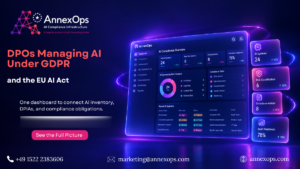
A DPO Dashboard is a centralized workspace that helps privacy and compliance teams manage data protection activities and monitor relevant information.
When AI is involved, a dashboard can bring together information about AI systems, data processing, risk assessments, documentation, and compliance tasks.
For example, DPOs may need to track:
- AI systems used across the organization
- Personal data processed by each system
- System owners and providers
- DPIA status
- AI risk assessments
- Applicable compliance obligations
- Supporting documentation and evidence
- Outstanding compliance tasks
Having this information in one place can make it easier to understand the organization’s current compliance activities.
Connecting GDPR and EU AI Act Compliance
The GDPR and EU AI Act have different requirements, but they can overlap when AI systems process personal data.
For instance, an organization using an AI application may need to consider its data protection responsibilities while also determining whether specific EU AI Act requirements apply to that system.
This makes coordination between privacy and AI governance important.
A GDPR and EU AI Act compliance dashboard can help organizations connect relevant assessments and activities instead of maintaining completely separate records.
The purpose is not to treat both regulations as one framework. Rather, it is to provide teams with a centralized view of the systems and compliance activities that may need to be managed.
Why an AI Inventory Matters
Before organizations can effectively manage AI compliance, they need to know which AI systems they have.
An AI inventory can record important information such as the system’s purpose, provider, owner, data categories, use case, and risk classification.
For DPOs, this visibility can help identify systems that may require additional privacy review.
An AI inventory can also support ongoing governance because information can be updated when systems change or new AI applications are introduced.
Without a centralized inventory, AI tools adopted by different departments can become difficult to track.
Managing DPIAs and AI Risk Assessments
A Data Protection Impact Assessment (DPIA) may be required when processing is likely to result in a high risk to individuals.
AI systems that process personal data may therefore require careful privacy assessment, depending on their processing activities and associated risks.
At the same time, organizations may need to conduct an AI risk assessment to understand the system’s regulatory position under the EU AI Act.
Keeping these activities connected to the relevant AI system can make compliance management more organized.
A DPO dashboard can help teams track assessment status, identified risks, mitigation measures, responsible stakeholders, and supporting documentation.
Keeping Compliance Evidence Organized
Compliance management also involves maintaining appropriate records and evidence.
For AI governance, organizations may need information about system characteristics, risk assessments, technical documentation, policies, and other relevant records.
For privacy operations, documentation may include DPIAs, processing information, and risk assessments.
An AI compliance dashboard can provide a centralized environment for associating relevant documentation with the appropriate AI system or compliance activity.
This can make internal reviews and ongoing monitoring more structured.
From Spreadsheets to Continuous AI Governance
Spreadsheets can be useful for organizations with a limited number of AI systems. However, they can become harder to maintain as AI adoption increases.
Different departments may create separate versions, ownership can become unclear, and information can become outdated.
A centralized dashboard can support a more continuous approach to AI governance:
Discover → Assess → Classify → Document → Review → Monitor
This workflow helps organizations treat compliance as an ongoing operational process rather than a one-time exercise.
How AnnexOps Supports DPOs
Organizations looking to centralize GDPR and EU AI Act compliance activities can explore the AnnexOps DPO Dashboard.
AnnexOps provides software designed to support AI compliance operations, including AI discovery, risk classification, compliance activities, documentation, and evidence management.
The AnnexOps DPO Dashboard gives DPOs and compliance teams a centralized view of relevant AI governance and privacy activities.
You can learn more about the AnnexOps DPO Dashboard and explore how it supports GDPR and EU AI Act compliance operations.
Final Thoughts
As AI adoption increases, DPOs need better visibility into the systems processing data and the compliance activities associated with them.
A DPO Dashboard can bring AI inventories, DPIAs, risk assessments, documentation, and compliance tasks into a more structured workflow.
For organizations managing both GDPR and EU AI Act requirements, centralized compliance management can provide a practical way to maintain oversight as AI systems and business processes evolve.
Contact us: +49 1522 2383606
Email at: marketing@annexops.com