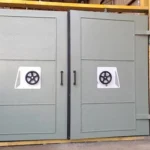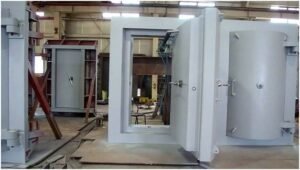
Blast resistant doors are specialized architectural components engineered to protect people, equipment, and structures from the destructive forces of explosions. Unlike standard doors, these systems are designed to absorb, deflect, or withstand the pressure waves, fragmentation, and structural shock generated by an explosive event, while maintaining structural integrity long enough for occupants to evacuate or for critical operations to continue safely.
Why Blast Resistant Doors Matter
Explosions—whether accidental (industrial mishaps, gas leaks, chemical reactions) or intentional (terrorism, sabotage)—generate a rapid release of energy in the form of a shockwave. This shockwave can cause catastrophic structural failure, flying debris, and secondary hazards if a building’s openings aren’t reinforced. Doors are often the weakest point in a structure’s envelope because they must open and close, which makes them inherently less rigid than solid walls. Blast resistant doors close this vulnerability gap by matching the strength of surrounding walls while still functioning as usable access points.
Common Applications
These doors are used across a range of high-risk and high-security environments, including:
- Government and military facilities – embassies, defense installations, and command centers requiring protection against attacks
- Oil, gas, and petrochemical plants – control rooms and processing areas where explosive hazards are a routine operational risk
- Power plants and utility infrastructure – including nuclear facilities, where redundancy and containment are critical
- Data centers and financial institutions – protecting sensitive infrastructure from targeted attacks
- Mining operations – where underground blasts pose regular safety hazards
- Commercial and public buildings – increasingly incorporated into airports, courthouses, and high-profile structures as a precautionary measure
Design and Construction Features
Blast resistant doors are typically constructed from heavy-gauge steel, often incorporating multiple layers or composite materials to distribute and absorb impact energy. Key design elements include:
Reinforced frames – The door frame is anchored deeply into surrounding structural walls, often with steel plates and expansion bolts, ensuring the entire assembly acts as a unified barrier rather than a weak point.
Heavy-duty hinges and locking mechanisms – Multi-point locking systems and blast-rated hinges prevent the door from being blown off its frame, even under extreme pressure loads.
Pressure rating and testing – Doors are rated according to the peak pressure (measured in psi) and impulse they can withstand, based on standardized testing protocols such as those from the U.S. Department of Defense (UFC 4-010-01), GSA guidelines, or European EN 13123/13124 standards.
Sealing systems – Many designs also incorporate airtight seals to prevent pressure wave penetration and, in some cases, to offer secondary protection against chemical or biological agents.
Aesthetic integration – Modern blast doors are increasingly designed to blend with conventional architecture, avoiding the “bunker” appearance while still meeting rigorous safety standards.
Regulatory Standards
Blast resistant doors must comply with strict national and international standards depending on their application and location. In the United States, relevant guidelines come from the General Services Administration (GSA), the Department of Defense’s Unified Facilities Criteria, and ASTM testing standards (such as ASTM F2247 and F1642). In Europe, EN 13123 and EN 13124 outline resistance classifications against explosion pressure. Facilities in high-risk sectors often need third-party certification and site-specific engineering analysis to determine the appropriate blast rating for their doors.
Choosing the Right Door
Selecting a blast resistant door requires a detailed risk assessment, factoring in:
- The anticipated threat level and explosive yield
- Standoff distance from potential blast sources
- Required pressure and impulse ratings
- Integration with existing security systems (access control, fire safety, surveillance)
- Maintenance and lifecycle costs
Conclusion
As threats to infrastructure—both accidental and deliberate—continue to evolve, blast resistant doors remain a critical line of defense in protecting lives and assets. Their combination of engineering precision, regulatory compliance, and adaptability makes them indispensable in sectors where safety cannot be compromised. Organizations investing in these systems should work closely with structural engineers and certified manufacturers to ensure their doors meet the specific blast threat profile of their facility.