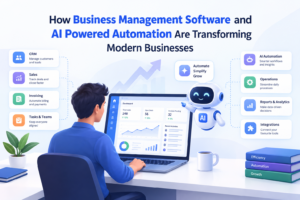
Managing a growing business involves more than selling products or delivering services. Teams need to handle customers, sales, invoices, employees, inventory, communication, reporting, and daily operations while making quick and informed decisions.
However, many businesses still depend on spreadsheets, emails, messaging apps, accounting tools, and separate CRM systems to manage these activities. While each tool may solve a specific problem, managing information across multiple disconnected systems can create unnecessary work.
This is where Business Management Software can make a difference.
A connected business management system brings important processes together, giving teams better visibility and reducing repetitive manual work. When combined with AI Powered Automation, it can go beyond simply storing information by helping businesses process data, automate tasks, identify patterns, and support everyday decision-making.
What Is Business Management Software?
Business Management Software is a digital solution that helps businesses manage multiple operational activities through a connected system.
Depending on the business, it can include:
- Customer relationship management
- Sales pipeline management
- Invoicing and billing
- Business dashboards
- Workflow automation
- Customer data management
- Reporting and analytics
- Team and task management
- Third-party integrations
- Operational tracking
Instead of employees moving information between several applications, connected software allows information to flow between different business processes.
For example, when a new customer enquiry arrives, the system can capture the lead, assign it to the right salesperson, track follow-ups, manage the sales opportunity, and connect the process with invoicing or other workflows.
This creates a more organized flow from:
Lead → Sales → Follow-Up → Customer → Invoice → Reporting
The Problem With Disconnected Business Tools
Many businesses do not have a lack of software. Instead, they have too many disconnected tools.
Sales information may be stored in a CRM, financial information in accounting software, operational data in spreadsheets, and customer conversations across email or messaging platforms.
This can create several challenges.
Scattered Information
Employees may have to search through different systems to find customer or business information. Managers may also need data from multiple sources before understanding what is happening.
Repetitive Data Entry
When applications do not communicate with each other, employees may have to enter the same information multiple times. This takes time and increases the possibility of errors.
Missed Follow-Ups
When follow-ups depend on spreadsheets, personal reminders, or messages, important opportunities can be overlooked.
Time-Consuming Reports
Business leaders need accurate information to make decisions. But collecting information manually from different systems can make reporting slow and inefficient.
Limited Visibility
Different departments often see only their part of the business. A connected system can provide a more complete view of customers, sales, operations, and financial activities.
How Business Management Software Helps
The primary value of Business Management Software is not simply having more features. It is connecting business processes.
Consider a customer journey.
A customer submits an enquiry through a website. The lead is captured and assigned to a salesperson. The salesperson follows up, updates the opportunity, and sends a quotation. Once the customer agrees, the next business process can be triggered.
Instead of treating every activity separately, the system connects them.
This reduces unnecessary manual steps and provides teams with greater visibility into what is happening.
What Is AI Powered Automation?
Traditional automation generally follows predefined rules.
For example:
When a new lead arrives → assign it to the sales team.
When an invoice is created → notify the finance team.
When a task is completed → move the workflow to the next stage.
AI Powered Automation adds another layer of intelligence to these workflows.
AI can help interpret information, summarize conversations, classify data, extract information from documents, identify patterns, and support employees with suggested actions.
Businesses can use AI to assist with activities such as:
- Lead classification
- Customer conversation summaries
- Document processing
- Data organization
- Follow-up assistance
- Business summaries
- Workflow recommendations
- Information retrieval
The purpose is not necessarily to replace employees. Instead, AI can reduce repetitive work and allow employees to spend more time on activities that require communication, creativity, judgment, and decision-making.
Business Management Software + AI Powered Automation
The combination of Business Management Software and AI Powered Automation can create a more connected and intelligent business workflow.
For example, imagine a company receiving hundreds of enquiries every month.
A traditional system may simply store those enquiries.
A rule-based automation system could assign them to different sales representatives.
An AI-powered workflow could additionally help understand the enquiry, categorize the requirement, summarize the customer’s request, and suggest the next action.
This reduces the amount of manual processing required from employees.
The workflow can look like:
Customer Enquiry → AI Processing → Classification → Suggested Action → Automated Workflow → Team Review
The exact process will depend on the business, but the goal is the same: use technology to remove unnecessary manual steps.
Key Benefits of AI Powered Automation
1. Reduce Repetitive Work
Employees often spend hours performing administrative tasks such as organizing information, updating records, processing documents, and preparing routine reports.
AI-powered workflows can automate or assist with these activities.
2. Improve Lead Management
Leads can come from websites, advertising campaigns, social media, email, and other channels.
A connected system can bring leads into a central workflow while AI can assist with categorization, prioritization, and follow-up.
3. Process Business Documents
Businesses work with quotations, invoices, purchase orders, forms, and reports.
AI can help extract relevant information from these documents and organize it within the appropriate workflow.
4. Access Information Faster
Employees often need information before completing a task.
AI can help retrieve and summarize relevant business information, reducing the time spent searching through different systems.
5. Improve Business Visibility
Dashboards can bring important information into one place.
When different workflows are connected, managers can get a clearer view of sales, customers, operations, and other activities.
6. Support Better Decisions
Business systems collect large amounts of information.
AI can help turn that information into summaries and useful insights, allowing decision-makers to spend more time interpreting information instead of manually collecting it.
Why Custom Business Management Software Matters
Every business operates differently.
A manufacturing company may need production tracking and operational dashboards. A retail company may focus on sales, inventory, and customer information. A service company may require lead management, project workflows, invoicing, and customer communication.
A generic software platform may offer many features, but businesses may still have to change their processes to fit the system.
A custom approach starts with understanding the business workflow.
The software can then be designed around the company’s actual requirements, including custom dashboards, CRM stages, approval processes, integrations, invoicing workflows, and automation.
This creates a system that supports the way teams actually work.
How Dhumi Approaches Business Management Software
Dhumi follows a workflow-first approach to Business Management Software.
Instead of asking businesses to completely change their existing processes, the approach begins by understanding how the business operates. Workflows can then be mapped, bottlenecks identified, and software designed around those requirements.
Dhumi’s business management solution brings capabilities such as CRM, dashboards, invoicing, automation, integrations, and AI-powered workflows together in a connected system.
The solution is designed around four key stages: understanding and mapping the workflow, designing the system around the actual business process, launching a working solution, and continuously improving it as business requirements evolve.
For businesses operating in India, the solution also highlights capabilities such as GST-ready invoicing and WhatsApp integration.
What to Consider Before Choosing Business Management Software
Before selecting a platform, businesses should consider more than the number of features available.
Does it fit your workflow?
The software should support the way your team actually works.
Can it integrate with existing tools?
Check whether your important business applications can be connected.
Can workflows be customized?
Different businesses have different processes, so automation should be adaptable.
Can AI solve a real business problem?
AI should be applied where it can provide practical value rather than being added simply as a feature.
Can the system grow with your business?
Your software should be able to evolve as your customers, employees, and operations increase.
Will your team use it?
A powerful platform is only valuable when employees can use it effectively in their daily work.
Conclusion
Modern businesses need more than individual software tools. They need connected systems that help people manage work more efficiently.
Business Management Software can bring CRM, sales, invoicing, dashboards, reporting, and operational workflows into a connected environment. AI Powered Automation can make those workflows more intelligent by assisting with repetitive tasks, document processing, lead management, information retrieval, and business analysis.
The goal is not simply to add more technology.
The goal is to make business operations easier to manage.
When software is designed around real business workflows and AI is applied to meaningful tasks, businesses can reduce manual effort, improve visibility, and create more connected operations.
For businesses looking to move beyond spreadsheets, disconnected applications, and repetitive processes, combining Business Management Software with AI Powered Automation can provide a practical foundation for building smarter and more scalable business operations.