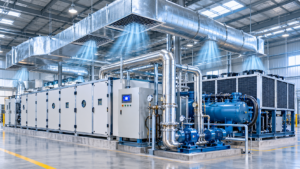
Indoor air quality is an important consideration for modern industrial and commercial facilities. Dust, airborne particles, excess humidity, heat and insufficient ventilation can affect working conditions and create challenges for sensitive manufacturing operations. Businesses therefore need reliable solutions that regulate indoor temperatures while supporting proper air circulation and filtration.
Modern HVAC Systems combine heating, ventilation and air conditioning to create controlled indoor environments. Depending on their configuration, these installations can manage temperature, humidity, fresh-air supply and airborne particles. Selecting appropriate equipment from experienced HVAC Systems Manufacturers helps businesses match environmental control requirements with their operational needs.
Understanding the Connection Between HVAC and Indoor Air Quality
Indoor air quality depends on several factors, including ventilation, filtration, humidity and the presence of airborne contaminants.
An HVAC installation can help manage these conditions through coordinated equipment and controls. Ventilation introduces outdoor air, filtration captures selected airborne particles, and heating or cooling equipment maintains the required temperature.
However, HVAC equipment alone does not guarantee clean air. Correct design, suitable filtration, adequate outdoor-air supply and regular maintenance are essential for achieving the intended results.
Important HVAC Components That Support Air Quality
1. Air Handling Units
Air handling units are important parts of many centralized HVAC arrangements. They move air through a building and may include filters, cooling coils, heating coils, fans and other components.
Their configuration depends on the building’s air-conditioning and ventilation requirements.
2. Air Filters
Filters remove airborne particles from circulating air. Different filter grades are available for different applications.
Industrial facilities should select filters according to particle size, air quality objectives, airflow requirements and system compatibility.
3. Ventilation Systems
Ventilation equipment supplies outdoor air and removes unwanted indoor air. Proper ventilation can help control indoor pollutant concentrations and support a healthier working environment.
4. Cooling and Heating Coils
Cooling and heating coils regulate air temperature. Cooling coils may also remove moisture from air when operating conditions permit condensation.
5. Humidity Control Equipment
Humidity management is important in environments where moisture levels influence products, materials or manufacturing processes. Suitable equipment and controls should be selected according to the required operating range.
Industrial Applications Requiring Controlled Air Quality
Different industries have different environmental requirements.
Pharmaceutical facilities: Manufacturing and storage areas may require controlled temperature, humidity and filtration based on the specific process and regulatory requirements.
Food processing plants: Ventilation and temperature management can support suitable production conditions and help manage moisture.
Electronics manufacturing: Certain production areas require carefully managed airborne particles to protect sensitive components.
Automotive manufacturing: Ventilation helps manage heat and airborne contaminants generated during selected production activities.
Commercial buildings: Proper ventilation and temperature control support occupant comfort and indoor air quality.
Businesses should assess each application independently rather than adopting a standard HVAC configuration for every building.
For further information about system configurations, explore HVAC Systems.
How to Maintain Good HVAC Performance
Regular maintenance is essential for maintaining airflow, temperature control and filtration performance.
Consider these practices:
- Inspect and replace filters according to their condition and manufacturer recommendations.
- Clean cooling coils and check for dust accumulation.
- Inspect fans, belts, motors and electrical connections.
- Check condensate drainage to prevent water accumulation.
- Monitor temperature and humidity sensors.
- Verify ventilation rates and airflow distribution.
- Inspect ducts for leakage and contamination.
- Maintain operating records and service schedules.
Facilities with specialized air-quality requirements may also need periodic testing and verification by qualified professionals.
Choosing Reliable HVAC Systems Manufacturers
A suitable manufacturer should understand the relationship between ventilation, filtration, temperature and the specific industrial application.
When comparing HVAC Systems Manufacturers, evaluate:
- Technical understanding of industrial HVAC requirements.
- Available air handling and cooling configurations.
- Filtration options and compatibility.
- Equipment specifications and documentation.
- Customization capabilities.
- Installation and commissioning support.
- Maintenance and after-sales assistance.
It is also important to clarify which filtration efficiencies, environmental conditions and performance levels are included in the proposed equipment.
How Aquatech Plus Supports Industrial Requirements
Aquatech Plus focuses on designing, manufacturing and installing industrial systems such as chillers, water purification units and beverage production lines.
With more than 15 years of experience, the company emphasizes customized, energy-efficient and reliable engineering solutions. Its industrial equipment knowledge supports businesses looking for suitable temperature-control and process-related solutions.
Companies evaluating HVAC Systems Manufacturers can explore Aquatech Plus’s offerings and discuss their specific requirements with the team.
Frequently Asked Questions
1. How do HVAC Systems improve indoor air quality?
They can improve indoor air quality through ventilation, air filtration, humidity management and controlled air circulation.
2. Which HVAC component is responsible for air filtration?
Air filters installed in the air handling or ventilation arrangement capture airborne particles according to their filtration rating.
3. Why is humidity control important in industrial facilities?
Excessive or insufficient humidity can affect products, materials, equipment and certain manufacturing processes.
4. How often should HVAC filters be replaced?
Replacement frequency depends on filter type, environmental conditions, operating hours and manufacturer recommendations. Filters should be inspected regularly.
5. Are HEPA filters necessary for every HVAC System?
No. HEPA filtration is required only for applications with specific high-efficiency filtration needs. The system must also be designed to support the required airflow and filter resistance.
Conclusion
Indoor air quality is an important part of industrial environmental management. Properly designed HVAC installations can support ventilation, filtration, humidity regulation and temperature control across different applications.
Businesses should evaluate their air-quality objectives, filtration requirements and maintenance capabilities before choosing equipment. Aquatech Plus provides industrial engineering and equipment solutions designed around different operational needs. Visit its HVAC webpage to explore available solutions and make an informed enquiry.