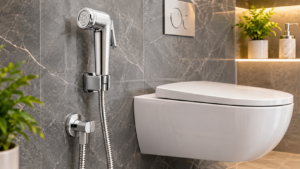
Choosing bathroom fittings involves more than selecting a design that matches the interiors. Material, construction, usability, and maintenance all influence how a product performs over time. This is particularly true when purchasing a health faucet, an everyday bathroom accessory used for personal cleaning.
Among the available options, ABS and brass health faucets are common choices. Both serve the same basic purpose, but their material characteristics, handling, appearance, and purchasing considerations are different.
So, which one should you choose? The answer depends on your budget, bathroom requirements, product specifications, and expectations. Understanding the differences can help homeowners, builders, dealers, and project buyers make a more informed decision.
What Is an ABS Health Faucet?
ABS stands for Acrylonitrile Butadiene Styrene, a thermoplastic material used in various consumer and bathroom products. ABS health faucets are generally lightweight and designed for convenient everyday handling.
Their lighter construction can make the spray head comfortable to hold. They are also available in different designs and finishes, depending on the manufacturer’s product range.
For buyers working within a defined project budget, ABS models may offer a practical option. However, the actual quality depends on the grade of material, manufacturing precision, trigger mechanism, and overall construction.
Before purchasing, check the product specifications rather than assuming that every ABS model offers identical performance.
What Is a Brass Health Faucet?
Brass is a metal alloy primarily made from copper and zinc. It is widely used in plumbing and bathroom fittings because of its useful mechanical properties and suitability for manufacturing different components.
A brass health faucet is often selected for its substantial feel and premium appearance. Depending on its construction and finish, it may complement contemporary and luxury bathroom interiors.
However, buyers should check exactly which components are made from brass. A product may contain a combination of materials, so the description should clearly identify the construction of the spray head, connections, and other parts.
The quality of finishing, internal mechanism, and assembly is just as important as the material itself.
ABS vs Brass: Understanding the Differences
The following comparison highlights general material characteristics. Actual performance varies according to product design and manufacturing quality.
- Weight and Handling
ABS models are generally lighter and may feel easier to handle during everyday use. Brass models usually have a more substantial feel because of their metal construction.
- Appearance
ABS health faucets are available in different shapes and finishes. Brass models can provide a premium metallic appearance, depending on their surface treatment.
- Construction
ABS is a plastic material, while brass is a metal alloy. Neither material alone guarantees product reliability. Component quality, manufacturing precision, and assembly should always be evaluated.
- Budget Considerations
ABS options may be suitable for buyers prioritising lightweight construction and budget considerations. Brass models may appeal to customers seeking a metal-based product and a particular aesthetic.
- Maintenance
Both types require appropriate cleaning and periodic inspection. The cleaning method should be suitable for the product’s surface finish and recommended by the manufacturer.
Which Health Faucet Is Suitable for Residential Bathrooms?
For residential use, comfort and convenience are important. An ABS model may suit households looking for a lightweight spray head and a practical everyday fitting.
A brass option may be preferable when the bathroom design includes coordinated metallic accessories or when the buyer specifically wants brass construction.
Consider the frequency of use, water pressure, hose quality, installation space, and ease of operation. If children or elderly family members will use the bathroom, trigger comfort and handling should also be considered.
Rather than selecting a product based only on its material, compare the complete design and specifications.
What Should Commercial Buyers Consider?
Builders, hotels, resorts, and property developers often purchase health faucets in larger quantities. Their requirements can differ from those of individual homeowners.
For commercial projects, product standardisation is important. Consistent models and specifications can simplify installation, inventory management, maintenance, and future replacements.
Buyers should evaluate:
- Material specifications and product construction.
- Trigger operation and hose quality.
- Connection compatibility and installation requirements.
- Packaging and batch consistency.
- Availability for repeat orders.
- Manufacturer communication and technical support.
Request product details before placing a bulk order. If a particular material is mandatory for the project, confirm that the supplied model meets that requirement.
Selecting the Right Manufacturing Partner
A good purchasing decision also depends on choosing a supplier that understands product requirements. When comparing Health Faucet Manufacturers, look for transparent material information, clear product descriptions, consistent specifications, and relevant quality documentation.
Avoid assuming that a higher price automatically means better performance. Similarly, the lowest-priced option may not provide the construction or features expected for a particular application.
Speed Bath Tech offers bathroom fitting solutions for customers exploring products for modern bathroom spaces. Buyers can visit its Health Faucet range to evaluate available options for their requirements.
For distributors and dealers, understanding the differences between ABS and brass models can also help when explaining product choices to customers.
The Final Choice Depends on Your Requirements
There is no single material that is automatically best for every bathroom. ABS can be a practical choice when lightweight handling and budget are important. Brass can appeal to buyers who prefer metal construction and a premium appearance.
The most effective approach is to compare complete product specifications, construction quality, installation compatibility, and maintenance requirements.
Whether you are purchasing one unit for your home or sourcing hundreds for a commercial project, an informed comparison helps you choose a health faucet that suits the intended application.
Frequently Asked Questions
1. Is a brass health faucet better than an ABS model?
Not necessarily. Brass offers metal construction, while ABS is generally lightweight. The better option depends on product quality, intended use, budget, and personal preference.
2. Are ABS health faucets suitable for everyday use?
They can be suitable for everyday use when manufactured with appropriate materials and components. Always check the product specifications and recommended operating conditions.
3. Does a brass health faucet require special maintenance?
It requires regular cleaning and inspection like other bathroom fittings. Use cleaning products compatible with its surface finish and follow manufacturer instructions.
4. Which health faucet is suitable for hotels?
Hotels should prioritise consistent product specifications, comfortable operation, suitable construction, maintenance requirements, and reliable replacement availability.
5. What should I check before ordering health faucets in bulk?
Confirm the material, model, hose specifications, connection type, packaging, quality documentation, delivery schedule, and repeat-order availability.