Everyone throws around “AI consulting” like it means one thing. It doesn’t. And if you’re a founder trying to figure out where to spend your limited budget, that confusion costs real money.
What’s the actual difference between AI strategy consulting and AI consulting solutions?
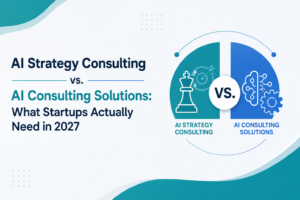
Think of it as the “what” versus the “how.”
AI strategy consulting (read more)is the upstream work — figuring out whether AI solves a real problem for your business, which use case to prioritize, and what success looks like before anyone writes code.
AI consulting solutions is the downstream delivery — the actual architecture, model selection, data pipeline design, and implementation roadmap that turns the strategy into something that runs in production.
Most startups skip straight to solutions without doing the strategy work first. That’s backwards, and it’s a big reason so many AI pilots never go anywhere.
Why do most AI projects still fail to reach production?
This isn’t a scare tactic, it’s a documented pattern. RAND Corporation research puts AI project failure at around 80% never reaching production. Gartner separately found that 63% of organizations either lack the right data management practices for AI or aren’t even sure whether they have them. A Cloudera and Harvard Business Review study went further, finding only 7% of enterprises consider their data completely AI-ready.
None of that is a technology problem. It’s a strategy problem. Teams build a demo, it looks impressive in a meeting, and then it stalls because nobody defined the data requirements, the ownership model, or what “done” actually means.
What should AI consulting solutions actually include for a startup?
A real solutions engagement — not a sales deck — should cover:
- Data readiness assessment — what you have, what’s missing, and what needs cleanup before any model gets built
- Architecture and platform selection — matched to your actual scale, not enterprise tooling you don’t need yet
- A lean pilot — a narrow, testable version of the solution instead of a six-month build
- Deployment and monitoring plan — because a model that isn’t monitored post-launch degrades quietly and nobody notices until it’s a problem
- A clear handoff point — knowing when the consultant’s job ends and your team takes over
If a proposal skips straight to “we’ll build you a custom LLM pipeline” without touching the first two points, that’s a red flag, not a shortcut.
How much should AI strategy consulting actually cost a startup?
There’s no single number, but the shape of the cost is predictable. Strategy-phase engagements are typically short and workshop-based — a few weeks, not months — because the deliverable is a roadmap and prioritization framework, not working software. Full solutions delivery costs scale with scope: a narrow pilot on one use case costs a fraction of a full production rollout.
The mistake founders make is comparing hourly rates across firms without comparing scope. A cheaper hourly rate on a bloated scope almost always costs more than a higher rate on a tightly defined pilot.
What questions should you ask before hiring an AI consulting partner?
Borrowing from what actually separates serious firms from sales-mode ones:
- Who does the actual work? Not who sold you the contract — who’s hands-on with your data and models.
- What would you recommend against for my situation? A firm that reframes every option as viable is selling, not advising.
- Can I talk to a technical reference, not just a business sponsor? Someone who worked with the team day-to-day, from an engagement that hit real friction.
- How do you measure success beyond the demo? Technical performance, business impact, and actual user adoption — all three.
- What’s your data readiness process before you touch a model? If they can’t answer this clearly, that’s the same gap Gartner’s 63% figure is describing.
When does a startup actually need AI strategy consulting versus just hiring a developer?
If you already know exactly which problem AI should solve, have clean data, and just need someone to build it — you probably need implementation help, not strategy. But if you’re still asking “should we even be doing this, and where,” that’s exactly the gap strategy consulting exists to close. Skipping it doesn’t save money — it just moves the cost downstream, usually into a rebuild.
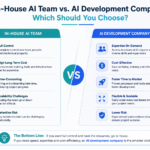
We’ve gone deeper into the budget-constrained version of this decision in AI Consulting for Startups: How to Build an AI Strategy on a Limited Budget, and compared the build-vs-buy tradeoff in detail in our in-house team vs. AI development company breakdown.
FAQs
Is AI strategy consulting only for large enterprises?
No — it matters more for startups, since the cost of a wrong AI bet is proportionally larger on a lean budget.
Can one firm handle both strategy and solutions delivery?
Yes, and it’s often more efficient, since the same team that scoped the problem understands the constraints when building it.
How long does an AI strategy engagement usually take?
Typically a few weeks — it’s a roadmap and prioritization exercise, not a build.
What’s the biggest sign an AI consulting firm is not a good fit?
They can’t name anything they’d recommend against for your specific situation.