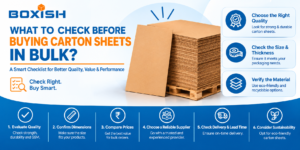
Businesses that purchase packaging materials in bulk need to consider more than just the price per unit. The quality, thickness, dimensions, and consistency of packaging materials can affect daily operations, product protection, and overall packaging costs. This is especially important when buying cardboard sheets wholesale for ecommerce, retail, manufacturing, and distribution requirements.
Cardboard sheets are widely used for product separation, surface protection, packaging support, and storage. They can be placed between products, used as protective layers inside cartons, or added to packaging to keep items organised during transportation.
However, not all cardboard sheets offer the same specifications. Differences in paper quality, GSM, thickness, and construction can influence their suitability for different applications. Businesses should understand these factors before placing a bulk order.
This guide explains how to compare cardboard sheets wholesale, evaluate material quality, understand thickness, and select a supplier that meets your business requirements.
Why Businesses Buy Cardboard Sheets Wholesale
Wholesale purchasing is useful for businesses that regularly consume packaging materials. Instead of placing small orders repeatedly, companies can plan their requirements and purchase suitable quantities in advance.
Some common reasons businesses buy cardboard sheets in bulk include:
-
Maintaining regular packaging inventory
-
Separating products inside cartons
-
Protecting surfaces from scratches
-
Creating layers between stacked products
-
Supporting warehouse packing operations
-
Managing packaging requirements across multiple locations
For example, an ecommerce business shipping different products may use cardboard sheets to separate items inside a carton. A manufacturer may use them between finished components to reduce direct contact during storage.
Bulk purchasing can also make procurement easier when the supplier offers consistent specifications and dependable delivery schedules.
1. Understand the Different Types of Cardboard Sheets
Before comparing prices, businesses should identify the type of sheet they need. The term cardboard sheets can refer to different paper-based materials and constructions.
Flat Cardboard Sheets
Flat cardboard sheets have a relatively simple structure and are used for general packaging, backing, product separation, and surface protection.
They can be suitable when businesses need a flat layer without the additional structure of corrugated board.
Corrugated Sheets
Corrugated sheets have a fluted paper layer between flat liner layers. This construction provides additional rigidity and cushioning compared with a simple flat sheet of similar paper weight.
They are commonly used for:
-
Product separation
-
Protective packaging layers
-
Industrial packaging
-
Internal carton support
-
Surface protection
The construction and performance depend on the number of layers, flute type, paper quality, and manufacturing specifications.
Brown and White Cardboard Sheets
Brown sheets offer a natural paper-like appearance and are commonly selected for practical packaging applications.
White sheets provide a cleaner surface and may be preferred when the material is visible or a white background is needed for printing.
The colour does not automatically determine the strength of the sheet. Businesses should compare the actual material specifications before purchasing.
2. Compare Paper Quality Before Buying in Bulk
Paper quality is one of the most important factors when selecting cardboard sheets wholesale.
Two sheets with similar dimensions and GSM may perform differently because of variations in paper grade, fibre composition, and manufacturing quality.
Before placing an order, check:
-
Paper grade and material composition
-
GSM specifications
-
Sheet thickness
-
Surface consistency
-
Cutting quality
-
Manufacturing finish
-
Suitability for the intended application
For example, sheets used for separating lightweight products may have different requirements from sheets used to support heavier components.
Request product samples and test them with your actual packaging process. This can help you evaluate whether the material is suitable before purchasing a large quantity.
3. Understand GSM and Cardboard Sheet Thickness
GSM and thickness are two important specifications when comparing cardboard sheets.
What Is GSM?
GSM stands for grams per square metre. It indicates the weight of paper per unit area.
A higher GSM generally means more paper weight per square metre, but it does not automatically guarantee greater strength or durability.
Why Does Thickness Matter?
Thickness describes how thick the sheet is. It can influence how the material behaves when stacked, handled, folded, or used as a protective layer.
When comparing sheets, businesses should consider both GSM and thickness rather than relying on only one measurement.
For example:
-
Thin sheets may suit basic product separation.
-
Medium-thickness sheets may work for general packaging support.
-
Thicker or corrugated sheets may be suitable when additional rigidity is required.
These are general applications, not fixed performance rules. The correct specification depends on the product, sheet construction, and packaging conditions.
4. Check Sheet Dimensions and Cutting Accuracy
Sheet dimensions should match the products and packaging process.
Incorrect dimensions can create additional cutting work, increase material waste, and slow down packaging operations.
Before ordering, confirm:
-
Standard sheet sizes
-
Custom length and width options
-
Cutting accuracy
-
Dimensional consistency
-
Tolerance for size variations
-
Availability of repeat orders in the same dimensions
For example, a business packing small electronic accessories may require compact sheets, while a furniture manufacturer may need larger sheets for surface protection.
Choosing suitable dimensions can help businesses use packaging material more efficiently.
5. Compare Cardboard Sheet Prices Wholesale
Price comparison is essential when purchasing packaging materials in bulk. However, businesses should compare quotations based on equivalent specifications.
A lower price may reflect a different GSM, paper grade, thickness, or sheet size.
Consider these factors when evaluating wholesale prices:
| Pricing Factor | What to Check |
|---|---|
| GSM | Compare sheets with similar paper weight |
| Thickness | Confirm the actual sheet thickness |
| Dimensions | Compare the same length and width |
| Paper quality | Check the material grade |
| Order quantity | Review quantity-based pricing |
| Customisation | Check cutting or special requirements |
| Transportation | Include delivery charges |
| Taxes | Confirm applicable taxes |
Ask suppliers to provide a clear quotation with product specifications and all applicable charges.
This makes it easier to understand the actual cost and avoid comparing products that are not equivalent.
6. Check Minimum Order Quantity and Bulk Discounts
Different manufacturers and suppliers may have different minimum order quantities (MOQs).
Before placing an order, confirm how much material you need and whether the supplier can provide that quantity.
Ask about:
-
Minimum order quantity
-
Price differences across order volumes
-
Availability of regular stock
-
Production time for large orders
-
Repeat-order arrangements
-
Custom-sized bulk orders
For businesses with regular packaging consumption, planning monthly or quarterly requirements can help manage inventory.
However, avoid purchasing more sheets than your business can store properly. Excess stock may occupy warehouse space and could be affected by moisture or unsuitable storage conditions.
7. Evaluate Surface Finish and Printing Requirements
The surface finish of a cardboard sheet can influence its appearance and suitability for certain packaging applications.
Brown sheets are often selected for practical packaging and natural-looking designs. White sheets may be more suitable when a clean background is needed for product information or printing.
If printing is required, check:
-
Whether the surface is coated or uncoated
-
Print compatibility
-
Ink absorption
-
Colour consistency
-
Logo and artwork requirements
-
Sample print quality
Do not assume that every cardboard sheet supports the same printing results. Ask the manufacturer to confirm the available printing options and request a sample if branding is important.
8. Understand How Cardboard Sheets Work With Other Packaging Materials
Cardboard sheets are often used alongside other packaging materials. Businesses can select suitable combinations according to product size, weight, shape, and transportation requirements.
Using Cardboard Sheets With a Corrugated Box
A corrugated box is commonly used as outer packaging for product storage and transportation. Its layered construction includes flat liner layers and a fluted paper layer, which contributes to its structural support.
Cardboard sheets can be placed inside a corrugated box to:
-
Separate multiple products
-
Create layers between stacked items
-
Protect selected surfaces
-
Organise products inside the carton
-
Reduce direct contact between packed items
For example, a manufacturer shipping multiple components in one carton may use cardboard sheets as dividers between individual products.
The sheet and box specifications should be selected according to the product’s weight, dimensions, stacking conditions, and handling requirements.
Using Cardboard Sheets With Corrugated Rolls
A corrugated roll offers flexible paper-based protection for products that need wrapping around their surfaces, edges, or corners.
Unlike fixed-size sheets, rolls can be cut to the required length. This makes them useful for items with different shapes and dimensions.
Common applications include:
-
Furniture components
-
Machinery parts
-
Selected glass products
-
Irregularly shaped items
-
Surface protection
-
Product edges and corners
For example, a furniture business may use corrugated rolls to wrap exposed surfaces and cardboard sheets to separate components inside the outer carton.
Using these materials together can support different stages of packaging. However, fragile or heavy products may require additional cushioning, inserts, or specialised protection.
9. Check the Supplier’s Manufacturing and Quality Control Process
A wholesale supplier should be able to explain how its products are manufactured, checked, and prepared for dispatch.
This is particularly important when your business depends on repeat orders.
Ask the supplier about:
-
Production facilities
-
Paper sourcing and grades
-
Sheet cutting equipment
-
GSM and thickness checks
-
Dimensional inspection
-
Batch consistency
-
Packaging before dispatch
-
Handling of damaged or incorrect orders
If possible, review the manufacturing facility or request samples from the same product range you intend to purchase.
A clear quality-control process can help reduce variations between deliveries.
10. Consider Delivery and Storage Requirements
Cardboard sheets are paper-based products, so proper storage and transportation matter.
Before confirming a bulk order, check whether the supplier can deliver the material safely and within the required timeline.
Consider:
-
Expected production lead time
-
Delivery location
-
Dispatch schedule
-
Packaging method
-
Protection against moisture
-
Order tracking and communication
-
Procedures for damaged deliveries
After receiving the sheets, store them in a clean, dry area. Keep them away from direct moisture and avoid placing excessive weight on stacks if it could cause bending or deformation.
Proper storage can help maintain the condition of the material until it is used.
11. Common Mistakes to Avoid When Purchasing Cardboard Sheets Wholesale
Businesses can avoid unnecessary costs by checking specifications carefully before placing bulk orders.
Choosing Only on the Basis of Price
The lowest quotation may not offer the paper quality or dimensions your business requires. Compare equivalent specifications before deciding.
Ignoring GSM and Thickness
A sheet may look suitable but perform differently under actual packaging conditions. Check both specifications and test samples.
Not Checking Dimensions
Incorrect sheet sizes can increase cutting work and material waste.
Skipping Sample Testing
Always evaluate samples before committing to a large order, especially when the sheets will be used for a new packaging application.
Overlooking Storage Conditions
Paper-based materials can be affected by moisture and poor handling. Plan suitable storage before ordering large quantities.
Not Confirming Repeat-Order Consistency
If your business requires regular supplies, discuss how the manufacturer will maintain the approved specifications across future orders.
12. Checklist Before Placing a Wholesale Order
Use this checklist to compare suppliers and finalise your purchase.
-
Confirm the type of cardboard sheet required.
-
Check paper grade and GSM.
-
Confirm thickness and sheet dimensions.
-
Review surface finish and colour.
-
Request and test a product sample.
-
Compare prices for matching specifications.
-
Confirm minimum order quantity.
-
Check customization options.
-
Review production and delivery timelines.
-
Confirm taxes, transportation, and payment terms.
-
Keep the approved specifications in writing.
Following these steps can make bulk purchasing more organised and help businesses select suitable packaging materials.
Packaging Material Solutions from Boxish
Boxish is an Indian manufacturer and wholesale supplier of packaging materials, operated by Memat Go Pvt. Ltd.
The company serves ecommerce sellers, retailers, restaurants, manufacturers, wholesalers, and distributors across India.
Its product range includes:
-
Corrugated boxes
-
Paper bags
-
Pizza boxes
-
Folding boxes
-
Corrugated sheets
-
Corrugated rolls
Businesses can explore corrugated sheets for product separation and protective packaging applications, as well as corrugated rolls for flexible wrapping requirements.
Boxish also offers packaging options with custom sizes and printing, depending on product specifications and order requirements.
Final Thoughts
Buying cardboard sheets wholesale requires a careful comparison of quality, GSM, thickness, dimensions, pricing, and supplier reliability.
Businesses should first identify their packaging requirements and then compare products with matching specifications. Requesting samples, checking manufacturing consistency, and confirming delivery terms can help prevent problems with bulk purchases.
It is also useful to consider how cardboard sheets will work with other packaging materials. A suitable combination of sheets, a corrugated box, and corrugated rolls can help businesses organise products and provide appropriate protection during storage and transportation.
The best purchasing decision is not always the one with the lowest price. It is the one that meets your packaging requirements, maintains consistent quality, and supports your business operations over time.
Frequently Asked Questions
1. What should businesses check when buying cardboard sheets wholesale?
Businesses should compare paper grade, GSM, thickness, dimensions, surface finish, order quantity, and pricing. It is also important to request samples and confirm delivery timelines before placing a bulk order.
2. Does higher GSM mean stronger cardboard sheets?
Not always. GSM measures paper weight per square metre, but strength also depends on fibre quality, thickness, construction, and manufacturing process. Test the material for its intended application.
3. Can cardboard sheets be purchased in custom sizes?
Many manufacturers offer custom sheet dimensions depending on their production facilities. Confirm available sizes, cutting accuracy, minimum order quantity, and customization charges.
4. What is the difference between cardboard sheets and corrugated sheets?
Flat cardboard sheets generally have a simpler construction, while corrugated sheets include a fluted layer between flat liners. Corrugated construction can provide additional rigidity and cushioning, depending on its specifications.
5. Can cardboard sheets be used with corrugated boxes and corrugated rolls?
Yes. Cardboard sheets can separate products inside a corrugated box, while corrugated rolls can wrap suitable products and protect selected surfaces. The materials can be combined according to the product and packaging requirements.