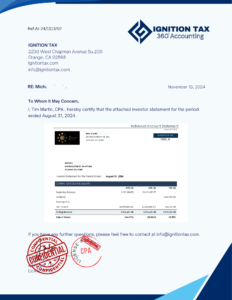
A CPA comfort letter is a written statement from a Certified Public Accountant (CPA) that provides a third party with specific factual information about a client, such as self-employment, business ownership, tax preparation, or financial information supported by records.
For borrowers, the term usually refers to a letter requested by a mortgage lender or other financial institution. The exact information required varies by lender, loan program, borrower circumstances, and what the CPA can professionally support.
What Is a CPA Comfort Letter?
A CPA comfort letter is a document prepared by a CPA to verify specific information about a client for a third party. In a mortgage context, it may help a lender verify facts about a self-employed borrower’s business, ownership, income history, or tax filings.
The word “comfort” can be misleading. A CPA letter is not automatically an opinion that a borrower is financially strong, will repay a loan, or will earn a particular amount in the future.
A CPA generally limits the letter to information that can be supported by the CPA’s records, work, and professional responsibilities. State accountancy boards and professional guidance have cautioned CPAs about making unsupported assurances to lenders or other third parties.
For that reason, the most useful CPA letter is usually specific, factual, and tailored to the requesting institution’s requirements.
Why Would a Mortgage Lender Ask for a CPA Comfort Letter?
A lender may request a CPA letter when additional third-party verification is needed for a self-employed borrower or business owner.
Self-employed borrowers can have more complicated income documentation than employees who receive W-2s and regular pay stubs. Business income may flow through a sole proprietorship, partnership, S corporation, or other entity, and the lender may need additional information to understand the borrower’s financial situation.
For example, a lender may want to verify:
- That the borrower is self-employed.
- The name and type of the business.
- The borrower’s ownership percentage.
- How long the borrower has operated the business.
- That the CPA prepared or reviewed particular tax returns or financial records.
- Specific historical income information supported by the CPA’s records.
- Other facts specifically requested by the lender.
A CPA letter is therefore supporting documentation, not a substitute for the lender’s normal underwriting process.
For example, Fannie Mae’s current guidance requires lenders to analyze self-employed income using appropriate documentation, including tax returns or transcripts in applicable circumstances. Freddie Mac also requires verification of the current existence of a business when positive self-employment income is used to qualify, with certain acceptable third-party and alternative sources.
Who Typically Needs a CPA Comfort Letter?
A CPA comfort letter is most commonly associated with borrowers whose income or business structure requires additional documentation.
You may encounter a request if you are:
- Self-employed.
- A business owner.
- An LLC owner.
- An S corporation shareholder.
- A partner in a business.
- An independent contractor or 1099 worker.
- A sole proprietor.
- A borrower using business income to qualify for a mortgage.
- A borrower using business assets for a down payment or other closing funds.
Not every self-employed borrower needs a CPA letter. Some lenders may verify the required information through tax returns, transcripts, business records, bank statements, licensing records, or other acceptable documentation.
The lender’s request should determine what you obtain rather than assuming that a standard CPA letter will satisfy the loan file.
What Information Does a CPA Comfort Letter Include?
The contents depend on what the lender or other requesting party needs and what the CPA can appropriately verify.
A letter may include:
|
Information |
What it may verify |
|
CPA’s identity |
CPA or accounting firm’s name and professional information |
|
Client identity |
Name of the borrower or client |
|
Business name |
Legal or operating name of the business |
|
Business structure |
Sole proprietorship, LLC, S corporation, partnership, etc. |
|
Ownership |
Borrower’s ownership interest when supported by records |
|
Self-employment history |
Period during which the borrower has been self-employed |
|
Tax preparation |
Whether the CPA prepared specified tax returns |
|
Historical income |
Specific figures supported by tax or accounting records |
|
Financial statements |
Whether specified statements were prepared or reviewed |
|
Business status |
Certain factual information about the business’s current existence |
|
Other lender-requested facts |
Narrow information relevant to the underwriting request |
The letter should not contain information simply because a lender’s template asks for it. The CPA must determine what can properly be stated based on the engagement, available records, and applicable professional requirements.
Can a CPA Comfort Letter Verify Income?
Yes, a CPA may be able to verify specific historical income information, but the scope depends on the CPA’s records and professional engagement.
For example, a CPA may be able to confirm income reported on tax returns that the CPA prepared or information contained in financial records the CPA reviewed.
That does not necessarily mean the CPA can certify that the borrower will continue earning the same income.
A distinction should be made between:
Historical fact:
“The tax return prepared by our firm reports $X of income.”
Future assurance:
“The borrower will continue earning $X per year.”
The first statement may be supportable based on the CPA’s work. The second involves a prediction that may go beyond what the CPA can appropriately provide.
Can a CPA Comfort Letter Guarantee Mortgage Approval?
No. A CPA comfort letter does not guarantee mortgage approval.
The lender makes the underwriting and credit decision. The lender may evaluate income, assets, liabilities, credit history, property value, debt-to-income ratios, business stability, and many other factors.
A CPA verifies or provides information within the appropriate scope of the CPA’s work. The CPA does not replace the lender’s underwriting process.
This distinction is especially important if a lender gives you a template containing language about solvency, repayment ability, future income, or guaranteed financial stability. A CPA may decline to sign language that goes beyond what the CPA can support.
What Is the Difference Between a CPA Comfort Letter and Other Financial Documents?
A CPA letter can sound similar to several other documents, but they serve different purposes.
|
Document |
Primary purpose |
|
CPA comfort letter |
Provides specific CPA-supported information requested by a third party |
|
Tax return |
Reports income, deductions, and other information to the IRS |
|
Tax transcript |
IRS record used to verify tax-return information |
|
Profit and loss statement |
Shows business revenue, expenses, and resulting profit or loss for a period |
|
Bank statement |
Shows account activity and balances |
|
CPA-prepared financial statements |
Present financial information under the applicable preparation, compilation, review, or audit framework |
|
Mortgage preapproval |
Indicates a lender’s preliminary assessment based on information and documentation reviewed at that stage |
A CPA comfort letter generally does not replace the other documents unless the requesting institution specifically says an alternative is acceptable.
How Do You Get a CPA Comfort Letter?
The safest approach is to start with the institution requesting the letter.
1. Ask the lender for its exact requirements
Before contacting a CPA, ask the loan officer or underwriting team:
- Do you specifically require a CPA letter?
- What facts must the letter verify?
- Do you have required wording?
- Does the letter need to be on CPA firm letterhead?
- Does it need a signature or license information?
- Does the lender require the CPA to send the letter directly?
- Is there a required date range for the information?
- Will an alternative document satisfy the condition?
This step can prevent you from paying for a letter that does not address the lender’s actual condition.
2. Give the CPA the lender’s request
Send the CPA the complete written requirement rather than summarizing it yourself.
The CPA can then determine which requested statements can be supported.
3. Provide supporting records
Depending on the request, the CPA may need access to records such as:
- Personal tax returns.
- Business tax returns.
- Tax transcripts.
- Profit and loss statements.
- Balance sheets.
- Business formation documents.
- Ownership records.
- Accounting records.
- Other documents relevant to the requested verification.
The exact documents depend on the requested letter and the CPA’s existing relationship with the client.
4. Authorize disclosure
Because the letter is being provided to a third party, the CPA may require written authorization before releasing client information.
Professional guidance has emphasized the importance of client authorization and the risks associated with third-party verification requests.
5. Review the completed letter
Before it goes to the lender, check that:
- Your name is correct.
- The business name is correct.
- Ownership information is accurate.
- Dates are correct.
- Income figures match the underlying records.
- The recipient is correct.
- The letter addresses the lender’s actual condition.
Do not edit a signed CPA letter yourself. If something is incorrect, ask the CPA to issue a corrected version.
What Documents Might You Need to Provide?
There is no universal document checklist because the CPA’s requirements depend on the requested verification.
A typical request may involve some combination of:
- The lender’s written letter requirement.
- Personal and business tax returns.
- Recent profit and loss statements.
- Business ownership documentation.
- Business registration information.
- Relevant accounting records.
- Identification and contact information.
- Written authorization to release information.
If the CPA already prepares your tax returns, the CPA may already have much of the information needed for a narrow verification letter.
If you use a new CPA who has not previously prepared or reviewed your records, expect the CPA to ask more questions before agreeing to make specific statements.
How Long Does a CPA Comfort Letter Take?
The turnaround time varies by CPA, the complexity of the request, the records available, and whether the lender has supplied clear instructions.
A straightforward request based on records already available to the CPA may be completed relatively quickly. A more complicated request may take longer because the CPA needs to review additional records or clarify what the lender is requesting.
If your mortgage closing is approaching, do not wait until the last minute. Send the lender’s written condition to the CPA as soon as you receive it.
Ignition Tax provides CPA letter services in the United States and can assist clients who need a CPA letter for a lender or another requesting institution.
How Much Does a CPA Comfort Letter Cost?
There is no universal U.S. price for a CPA comfort letter.
The cost can vary based on:
- The CPA’s fee structure.
- Complexity of the request.
- Amount of documentation that must be reviewed.
- Whether you are already a client.
- Turnaround time.
- Whether additional accounting work is required.
- Whether revisions are requested.
Some firms charge a flat fee for specific letter services, while others may bill based on time or the scope of the work.
Before ordering a letter, ask for the total fee and clarify what is included. Also ask whether substantial changes from the lender could result in additional work.
Who Accepts a CPA Comfort Letter?
A CPA letter may be requested by a:
- Mortgage lender.
- Bank.
- Business lender.
- Landlord or property manager.
- Other institutions conduct financial or self-employment verification.
Acceptance is not universal. The organization requesting the letter decides whether it meets its documentation requirements.
For mortgage transactions, even if a particular type of CPA letter has been accepted by one lender, another lender may require different wording or additional documentation.
This is why borrowers should obtain the lender’s specific requirements before requesting the letter.