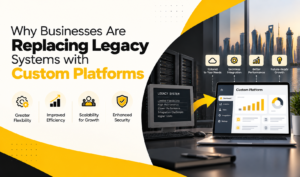
Legacy software systems have supported businesses for decades, but many organizations in Qatar and across the MENA region are now questioning whether their existing technology can support future growth.
As businesses expand, customer expectations increase, and digital operations become more complex, outdated systems can create operational bottlenecks, security risks, integration problems, and higher maintenance costs.
This is why businesses are increasingly moving from legacy applications to modern custom platforms designed around their specific processes and goals.
For startups, SMEs, and enterprises, custom software development can provide greater flexibility, scalability, and control while creating a stronger foundation for digital transformation.
What Are Legacy Systems?
Legacy systems are older software applications, databases, or technology platforms that businesses continue to use even though newer technologies are available.
A legacy system may still perform its original function, but it can become difficult to maintain or integrate with modern applications.
Common signs of a legacy system include:
- Slow system performance
- Limited scalability
- Outdated user interfaces
- Difficult third-party integrations
- High maintenance costs
- Security vulnerabilities
- Manual business processes
- Dependence on outdated technology
For businesses operating in competitive markets such as Qatar, Saudi Arabia, the UAE, and other MENA countries, these limitations can affect productivity and customer experience.
Why Are Businesses Moving Away from Legacy Systems?
1. Legacy Systems Limit Business Growth
One of the biggest problems with legacy software is that it may not scale effectively as a business grows.
An organization may add new employees, customers, locations, products, or services, but its existing platform may not be designed to handle increasing workloads.
A custom platform can be designed around current requirements while providing flexibility for future expansion.
For example, a growing Qatar-based retailer can develop a platform that integrates inventory, sales, customer data, and eCommerce operations instead of managing these functions through disconnected legacy systems.
2. Integration with Modern Technologies
Modern businesses rely on multiple technologies, including cloud platforms, payment gateways, CRM systems, ERP solutions, analytics tools, and AI.
Legacy applications may not have modern APIs or integration capabilities, making it difficult to connect them with newer systems.
A modern custom platform can be designed with APIs and integration capabilities from the beginning.
This allows businesses to connect internal systems with third-party platforms and create a more connected digital ecosystem.
3. Better Security and Compliance
Cybersecurity has become a major concern for organizations across Qatar and MENA.
Older systems may rely on outdated technologies, unsupported software components, or security practices that are no longer suitable for modern threats.
With custom software development services, businesses can build security requirements into the architecture from the beginning.
Depending on the application, this may include:
- Role-based access
- Secure authentication
- Data encryption
- Activity monitoring
- Regular security updates
- Secure API integrations
Businesses should also consider applicable regulatory and data protection requirements when modernizing their technology infrastructure.
4. Reduce Long-Term Technology Costs
Legacy systems may appear cheaper because the business already owns them. However, ongoing maintenance, specialist support, manual work, integrations, and infrastructure can make them expensive over time.
A modern platform can reduce unnecessary operational complexity by consolidating systems and automating repetitive workflows.
The goal of custom application development is not simply to replace old software. It is to create a more efficient technology environment that delivers measurable business value.
5. Improve Customer Experience
Customers increasingly expect fast, reliable, and convenient digital experiences.
Slow systems, complicated processes, limited self-service options, and inconsistent customer information can negatively affect customer satisfaction.
A custom platform can be designed around the actual customer journey.
For example, a business can provide customers with:
- Personalized dashboards
- Faster transactions
- Self-service options
- Mobile-friendly experiences
- Real-time updates
- Integrated customer support
This can help businesses create more consistent experiences across digital channels.
Custom Platforms Offer Greater Flexibility
Off-the-shelf software provides standardized functionality, but businesses may need processes that are unique to their industry or operating model.
A custom platform allows organizations to decide which features, workflows, integrations, and user roles are required.
This flexibility is particularly valuable for enterprises with complex processes.
An experienced custom software development company can work with business and technical teams to understand existing challenges and design a solution around specific requirements.
Agile Software Development Makes Modernization Faster
Replacing a legacy platform does not always require rebuilding everything at once.
With agile software development, businesses can modernize their technology in stages.
A typical approach may involve:
Step 1: Assess the Existing System
Identify outdated technologies, dependencies, security risks, integrations, and business-critical functions.
Step 2: Define Business Requirements
Determine which processes should be retained, improved, automated, or removed.
Step 3: Prioritize Development
Focus first on the features and workflows that provide the greatest business value.
Step 4: Develop and Test
Build the new platform using modern technologies while continuously testing functionality, performance, and security.
Step 5: Migrate and Integrate
Move relevant data and connect the new platform with essential business systems.
Step 6: Scale and Improve
Use customer and employee feedback to continuously improve the platform.
This incremental approach can reduce disruption while allowing businesses to modernize at a manageable pace.
Custom Platforms Support Digital Transformation
Legacy modernization is more than a technology upgrade. It can become an important part of a company’s wider digital transformation strategy.
Modern platforms can provide the foundation for:
- Artificial intelligence
- Business analytics
- Cloud computing
- Automation
- Mobile applications
- Real-time reporting
- IoT integrations
- Advanced customer experiences
For organizations in Qatar and MENA, this can help create a technology environment that is prepared for future innovation.
When Should a Business Replace Its Legacy System?
Not every old system needs immediate replacement. Businesses should consider modernization when the existing technology is creating measurable problems.
Key warning signs include:
- Increasing maintenance costs
- Frequent system failures
- Security concerns
- Poor performance
- Inability to integrate with modern tools
- Manual processes
- Limited scalability
- Poor customer experience
- Difficulty finding technical expertise for the old technology
A technology assessment can help determine whether a system should be replaced, upgraded, integrated, or gradually modernized.
Choosing the Right Software Development Partner
Legacy modernization requires both business and technical expertise.
A suitable software development company should understand your existing infrastructure, business processes, data requirements, security needs, and long-term objectives.
Businesses may also consider offshore software development when they need access to specialized technical expertise or additional development capacity. However, communication, technical quality, security, project management, and long-term support should remain key selection criteria.
For businesses seeking an experienced custom software development company in Qatar, BRQ can help design and develop technology solutions aligned with specific business requirements.
Conclusion
Businesses across Qatar and MENA are replacing legacy systems because outdated technology can limit growth, increase costs, create security risks, and prevent organizations from adopting modern digital capabilities.
Modern software development services can help businesses move toward flexible, scalable, secure, and integrated platforms.
The right modernization strategy does not necessarily mean replacing everything overnight. With a structured and agile approach, organizations can gradually transition from legacy technology to a custom platform designed for their future requirements.
If your existing software is limiting your business, now may be the right time to evaluate a modern solution.
Ready to modernize your legacy system? Explore custom software development services from BRQ and build a platform designed around your business goals.
Frequently Asked Questions
What is legacy system modernization?
Legacy system modernization is the process of upgrading, replacing, or restructuring outdated software and technology so that it can better support modern business requirements.
Why choose custom software instead of off-the-shelf software?
Custom software is designed around specific business processes, workflows, integrations, and requirements. This can provide greater flexibility and scalability than standardized software.
How long does custom software development take?
The timeline depends on application complexity, features, integrations, data migration, security requirements, and development scope. A detailed assessment is required to establish an accurate timeline.
Can legacy data be moved to a new platform?
Yes. Data migration can be included in a modernization project. The process should include data assessment, mapping, cleansing, migration, and validation.
Is agile development suitable for legacy modernization?
Yes. Agile development allows businesses to modernize systems incrementally, prioritize high-value functionality, test continuously, and incorporate feedback throughout development.
When should a business replace its legacy software?
Businesses should consider replacement when outdated technology creates security risks, high maintenance costs, integration problems, poor performance, scalability limitations, or significant operational inefficiencies.