Making a solar panel involves several technical steps. From connecting the solar cells to checking the finished module, care has to be taken at every stage. Among these, lamination is a stage that affects the panel’s strength, safety, and long-term performance. If the layers of a solar panel are not bonded together properly, damage can develop over time because of moisture, air, and dust. For this reason, PV module lamination is considered very important in the solar manufacturing industry.
What is PV Module Lamination?
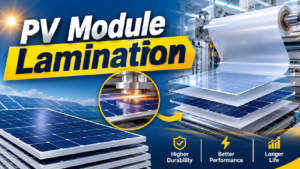
PV Module Lamination is a process used to make solar panels, in which different layers such as glass, solar cells, encapsulant, and backsheet are joined together. A special laminator machine is used for this, which firmly bonds all the layers through controlled temperature, vacuum, and pressure.
In this process, materials such as EVA (Ethylene Vinyl Acetate) or POE (Polyolefin Elastomer) are used. These encapsulants cover the solar cells from both sides and help protect them from the effects of the external environment.
The Lamination Process in Solar Panel Manufacturing
Before lamination begins, the different layers of the solar module are arranged in a fixed order. After that, the module is placed in the laminator machine. The entire process mainly has three stages.
1. Vacuum Process: First, the air is removed from the machine’s chamber. The purpose of this is to remove the air and gases trapped between the module’s various layers. If this process is not done properly, bubbles can form in the finished panel.
2. Heating and Curing: After that, the encapsulant material is heated at a controlled temperature. According to the characteristics of EVA or the other material used, it softens, spreads between the layers, and completes its curing under the specified process.
3. Cooling Process: After lamination is completed, the module is cooled in a controlled manner. This keeps the condition of the finished layers stable and prepares the panel for the next manufacturing stage.
In all three of these stages, proper control of temperature, time, and vacuum is very important.
Materials Used in PV Module Lamination
The quality of lamination also depends on which materials are being used in manufacturing.
EVA Film: This is a common encapsulant material used in solar panels. It helps bond the solar cells and other layers together.
POE Film: This is also used in the encapsulation of solar modules. In some module designs, its special electrical and moisture-related properties are useful.
Solar Glass: This protects the front surface of the panel and allows sunlight to reach the solar cells.
Backsheet: This acts as a protective layer on the back side of the module. However, in some modules, glass is also used on the back side instead of a backsheet.
Why is it important to maintain quality in the lamination process?
Solar panels are installed in open environments for a long time. They have to withstand heat, rain, moisture, and changes in temperature. Therefore, even a small mistake during lamination can later affect the quality of the module.
Due to an incorrect process, problems such as air bubbles in the panel, delamination, color changes, and weak bonding can occur. In some cases, the solar cells can also be damaged.
To avoid these problems, manufacturers monitor temperature uniformity, vacuum level, curing, and cooling. The finished module is visually inspected, an adhesion test is performed, and EL testing is also done as needed.
How do you choose the right PV Module Lamination Machine?
When buying a lamination machine for a solar panel manufacturing unit, it is important to understand production capacity and module size.
Check the machine’s chamber size, heating system, vacuum capacity, and temperature control features. In addition, pay attention to automation, the number of modules processed at one time, and the machine’s cycle time.
It is also important to get information from the machine manufacturer about technical support, spare parts, installation, and operator training. The machine should be chosen not just by its price, but according to the actual needs of production.
Conclusion
In the solar panel manufacturing process, the job of lamination is to turn the module’s various layers into a strong structure. PV module lamination done with the right temperature, vacuum, and curing plays an important role in maintaining the panel’s quality and reliability. Therefore, during solar manufacturing, it is necessary to choose a good machine, suitable materials, and the correct technical process.